
Day Off, Power On: Labor Day Rap Session
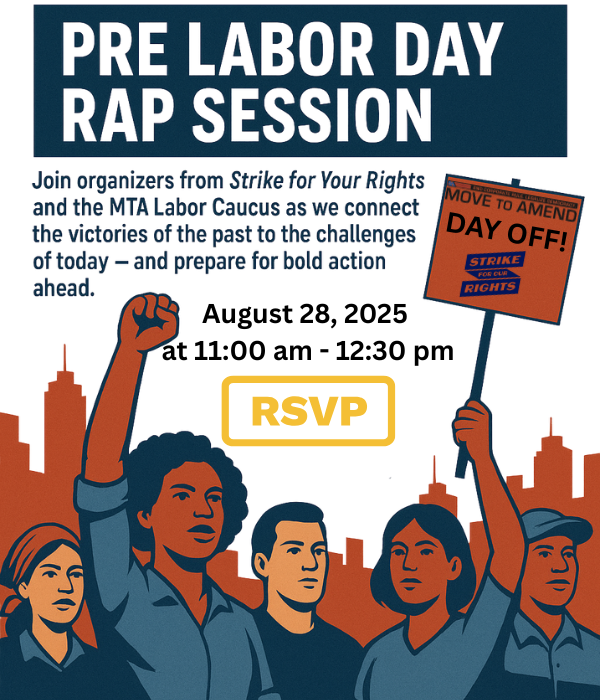 This Labor Day, we invite you to step into the long tradition of courage, solidarity, and struggle that has shaped our workplaces, our communities, and our aspiring democracy.
Join organizers from Strike for Your Rights and the MTA Labor Caucus as we connect the victories of the past to the challenges of today — and prepare for bold action ahead.
Read moreWe Need Your Help to Reach More People — Who Do You Know?
📣 Billionaires have the megaphones. We have the people — but we need to be LOUDER.
Move to Amend has a bold mission: pass the We the People Amendment (HJR 54) to end corporate constitutional rights and the false doctrine that money equals speech. Right now, we need to break through to a much bigger audience.
Many issues will never be fully resolved until this one is. We’re fighting dozens of battles: climate collapse, authoritarianism, income inequality, safe food, preserving social and economic safety net programs, gun safety – but none of these can be fully won while corporations have constitutional rights and unlimited money buys political power.

When women stop. The world stops!
On August 18, 1920, after 75 years of relentless struggle, the 19th Amendment was finally ratified. It boldly declared:
“The right of citizens of the United States to vote shall not be denied or abridged by the United States or any State on account of sex.”
It was a watershed moment — the fruit of organizing, sacrifice, and persistence across generations. But history teaches us: rights won are never rights guaranteed.
Today, more than a century later, women are still demanding to be fully recognized as equals under the law. The Equal Rights Amendment (ERA)—first introduced in 1923— is currently in a unique legal position. Although it has been ratified by three-fourths of U.S. states, it has not yet been formally codified in the Constitution as the 28th Amendment, leaving women vulnerable to rollbacks on hard-won rights.
Even more disgusting, corporations have been granted sweeping constitutional rights—the rights of “persons” under the law. This distortion of democracy is why corporations can pour unlimited money into our elections, poison our communities, and put profits over people without accountability.
The contradiction is stark:
- Women fought 75 years for the vote.
- We’ve struggled for over 100 years for constitutional equality.
- Corporations have amassed more rights than people.
That’s why we’re building a movement for the We the People Amendment (currently HJR54) — to affirm that only human beings have constitutional rights and that money is not free speech. Our movement is about creating a genuine democracy free from corporate rule and finishing the work that generations before us began.
And we know this truth: change has always come from people coming together — refusing to be silent, refusing to be divided, and refusing to accept injustice as normal.
Read moreBig money investments from crypto and private equity interests threaten 401(k)s
If you’ve lucky enough to have a 401k retirement plan offered by your employer, beware. Private equity and cryptocurrency interests want a big piece of it.

SUMMARY
What are we talking about?
Private equity (PE) refers to firms that make monetary investments from wealthy individuals, pension funds and university endowments in companies that are not publicly traded.
Cryptocurrencies are a form of digital currency (also called “digital assets”) that allows people to make payments directly to each other through an online system that is not controlled by any one person, organization or nation state.
What happened?
Donald Trump signed an Executive Order on August 7 that would allow 401k workplace retirement funds totalling $12 trillion to invest in private equity firms and cryptos.
How did this happen?
Private equity corporations and cryptocurrency exchanges and their respective billionaire owners and investors donated massive sums in the 2024 political election - targeting Trump and pro-crypto Congressional candidates.
Why did this happen?
Private equity and cryptocurrencies pushed hard for these changes, to be sure, to increase their profits, but in the case of cryptos, to gain credibility.
What can we do about it?.
If you have a 401k, communicate to your employer that you don’t want a nickel of your hard earned retirement fund invested in risky, opaque and expensive ventures.
Support enacting HJR54, the We the People Amendment.
Read moreThe Corporate Coup & Why We Need the We the People Amendment (HJR54)
The We the People Amendment is the most fundamental and comprehensive solution to the deep, systemic crises we’re facing—not just the corrupting influence of money in politics, but the entire framework of corporate rule that has hijacked our democracy.

Right now, every front of justice is under assault: climate collapse, immigration, endless war, healthcare, workers' rights. And while those fires need to be fought—we also need to step back and name the arsonist.
Corporations, armed with constitutional rights they were never meant to have, are behind the curtain of every major injustice.
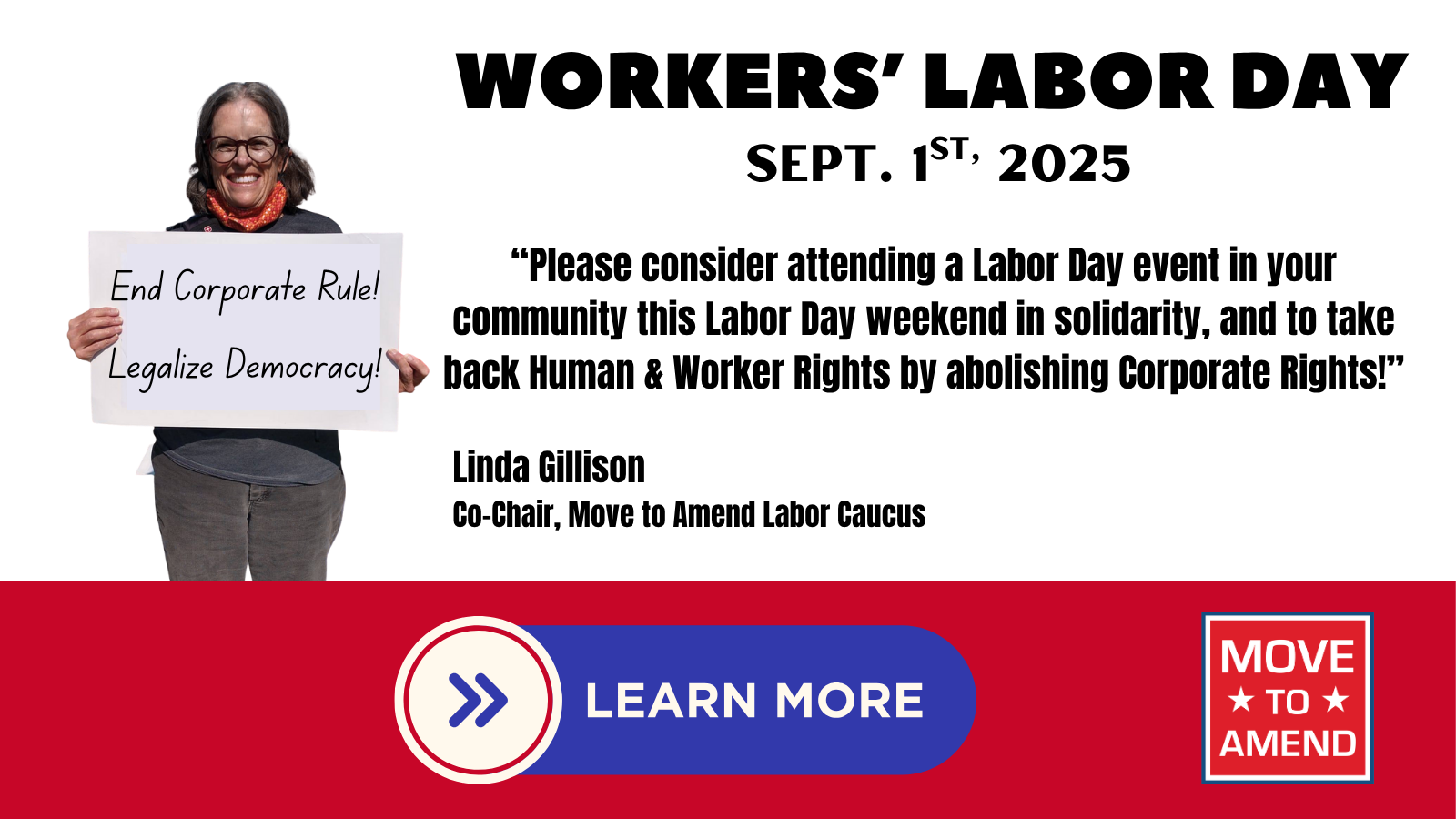
Read moreTake Action in Solidarity with Organized Workers this Labor Day
Labor is the only organized group that has consistently stood for worker's rights over corporate rule. Scores of economic, social and political justices have been championed by individual workers and organized working people who are members of labor unions -- sometimes working alone and other times in coalition with other organizations representing those who have been historically oppressed.
Affiliate & Advocate Spotlight - August 2025

This month, we’re highlighting the Santa Clara, CA affiliate for their strong efforts at the San Jose and Milpitas No Kings events, their lobbying for SB 42, and their success in securing HJR 54 co-sponsors. Our Minnesota affiliates are also making strides with impactful organizing. And we also wish to shine a bright light on our new Move to Amend advocates joining the movement!
Newsletter - August 2025

The August recess is upon us, and this is a critical time to push for the We the People Amendment (House Joint Resolution 54)!
As Congress heads back to their districts, your Representatives will be more accessible than ever—and it's the perfect opportunity for YOU to ask them to co-sponsor the amendment. Whether you're a seasoned advocate or just starting out, this is your moment to take action. Learn how!
Read moreShaker Heights Democracy Day Public Hearing - Sept 8
Shaker Heights Democracy Day - September 8
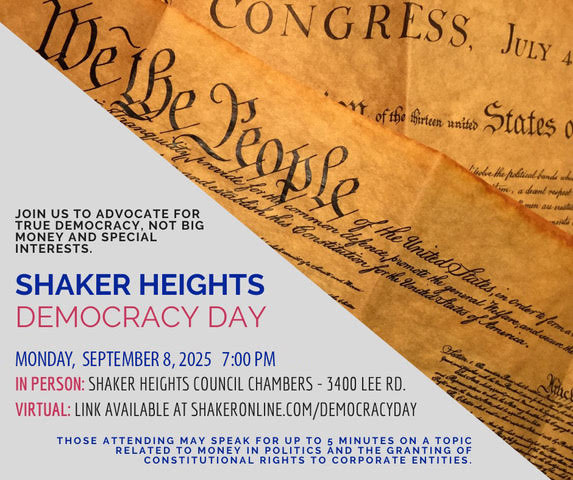
In 2016, Shaker Heights voters passed, with an 82% “yes” vote, Issue 95 in support of a 28th amendment to the U.S. Constitution, stating that:
- Only human beings, not corporate entities have constitutional rights, and
- Money is not speech, so money spent on elections can be regulated.
RSVP BELOW
Read moreMTA took Center Stage at the Money Out of Politics DC Rally
Move to Amend’s effort to end political corruption and create justice and democracy by passing the We the People Amendment was among THE most important and repeated messages at the national Money Out of Politics rally on July 27 on the steps of the Lincoln Memorial in Washington, DC.
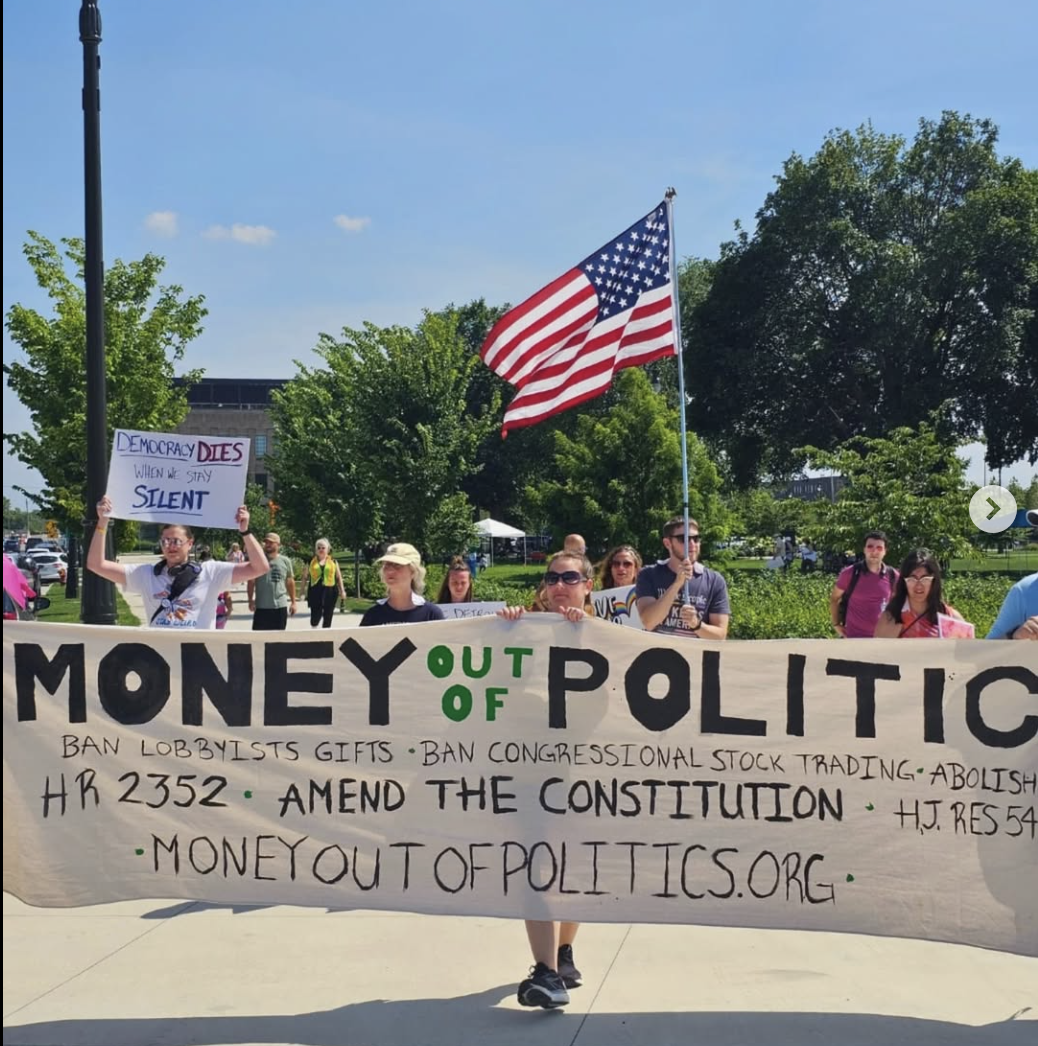
A nearby lightning-strike and monsoon-like rain one hour into the rally led the National Park Service to cut short the event – but not before 3 people spoke, including MTA Co-Director Greg Coleridge.
Read Greg’s speech HERE
Read more
