Affiliate and Advocate Spotlight - February 2026

Affiliate & Advocate Spotlight: Building Power Everywhere
Movements are not built in a single place, nor do they advance through a single tactic. They grow because people, in communities large and small, decide to show up—again and again—and connect what’s happening where they live to a larger structural problem.
Across the country, Move to Amend affiliates are doing exactly that: organizing locally while keeping their eyes on the constitutional crisis at the root of corporate power.
Recent actions in Ohio, Alabama, and Minnesota — now at the center of national attention in the fight to reclaim self-government — reveal what it looks like when communities organize for systemic change.
Read moreRecord Lobbying. Record Influence. This Is What Corporate Power Looks Like.
Corporate lobbying just hit record levels — who is government really working for?
Something important is happening in Washington right now — and most people only see it in fragments.
Banks are increasing lobbying spending. Tech companies are flooding Washington with influence campaigns. Defense contractors and financial firms are expanding their political operations. Lobbying firms themselves are reporting record profits as corporations race to shape policy before it is written.
This isn’t speculation. It’s happening in plain sight

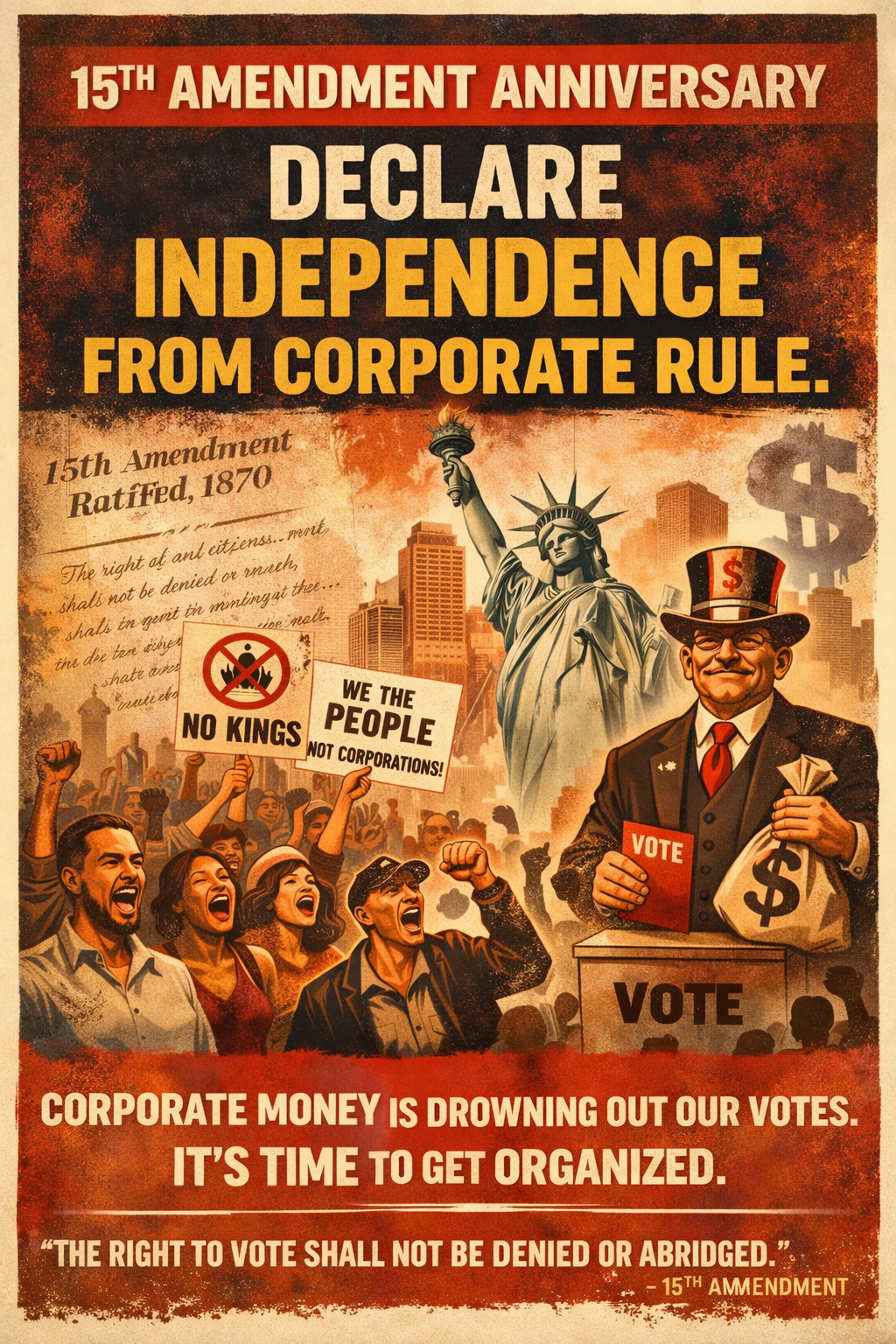
NO King #3
Two hundred and fifty years ago, people had the courage to say enough.
They didn’t politely ask an empire for reform. They didn’t wait for permission. They took direct action against concentrated corporate power and declared independence from a system that extracted wealth while denying self-government. The Boston Tea Party wasn’t just rebellion... it was resistance to corporate rule.
Today, we are living under a new empire.
Our unalienable rights are being stripped away in real time - not by monarchs or wannabe kings, but by corporations empowered through courts. Through judicial fiat, corporations have been granted constitutional rights they were never meant to have. These fabricated rights now serve as armor - shielding corporations from accountability while allowing them to dominate elections, write policy, poison communities, and extract wealth with impunity.
Meanwhile, We the People are told to accept shrinking freedoms.
Voting rights are under attack. Political equality is a myth when money determines whose voices are heard. The promise of democracy is hollow when artificial entities wield more power than living, breathing human beings.
Read more
Buckley v. Valeo: How Corporate Constitutional Rights Built an Authoritarian System
The U.S. Constitution was never a democratic document.
It was written to protect the political and economic power of a narrow ruling class: white male property owners. Enslaved people were excluded. Women were excluded. Indigenous nations were excluded. Poor people were excluded. Democracy, such as it exists at all in the United States, was not a gift from the founders — it was wrestled into existence through centuries of struggle.
The Constitution only began to move toward democracy through amendments: evidence of popular pressure forcing the system to expand who counts as “We the People.”
Roe, Then and Now: Join Us to Turn Grief into Collective Action
Each January, we are asked to remember Roe v. Wade not only as a Supreme Court decision, but as a hard-won recognition of women’s sovereignty over their own bodies — a recognition rooted in decades of organizing, risk, and sacrifice by those who refused to accept control by the state, by churches, or by economic elites.
Today, that promise has been systematically dismantled.
Across the country, we are witnessing coordinated attacks on bodily autonomy, reproductive freedom, access to health care, and the very idea that people — not corporations, politicians, or courts — should have the final say over their own lives. These attacks do not happen in isolation. They are fueled by big-money political systems that elevate corporate interests and ideological power over human rights and community well-being.
At Move to Amend, we understand that struggles for reproductive justice, racial justice, environmental justice, worker rights, and real democracy are deeply connected. They all ask the same fundamental question:
Who decides — the people, or concentrated wealth and power?
But we also know that living in this constant state of political crisis takes a real toll. Many of us feel overwhelmed, exhausted, angry, or discouraged — even as we remain committed to justice.
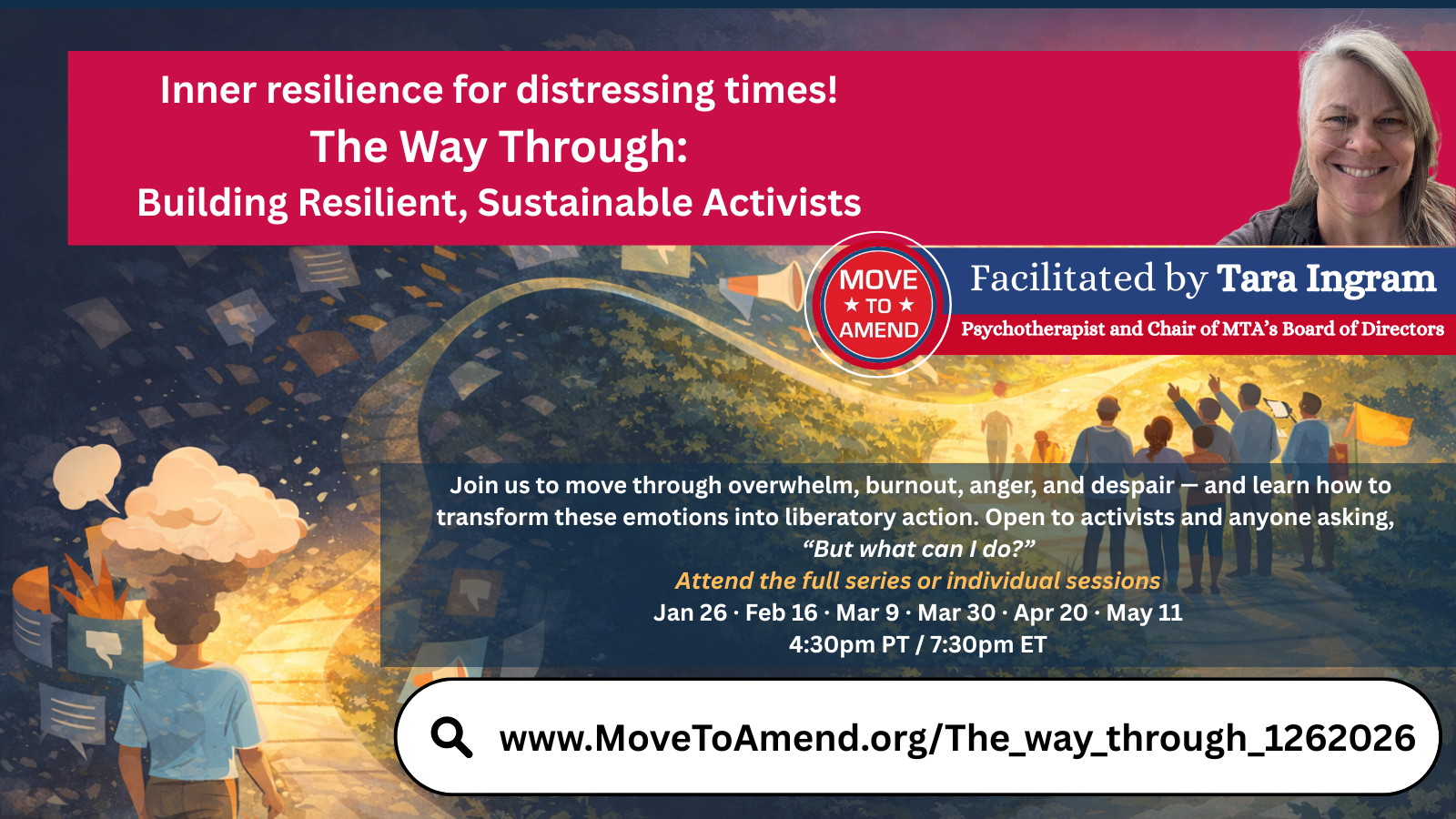
That’s why we’re inviting you to join us for a new 6-part learning and support series:
The Way Through: Building Resilient, Sustainable Activists
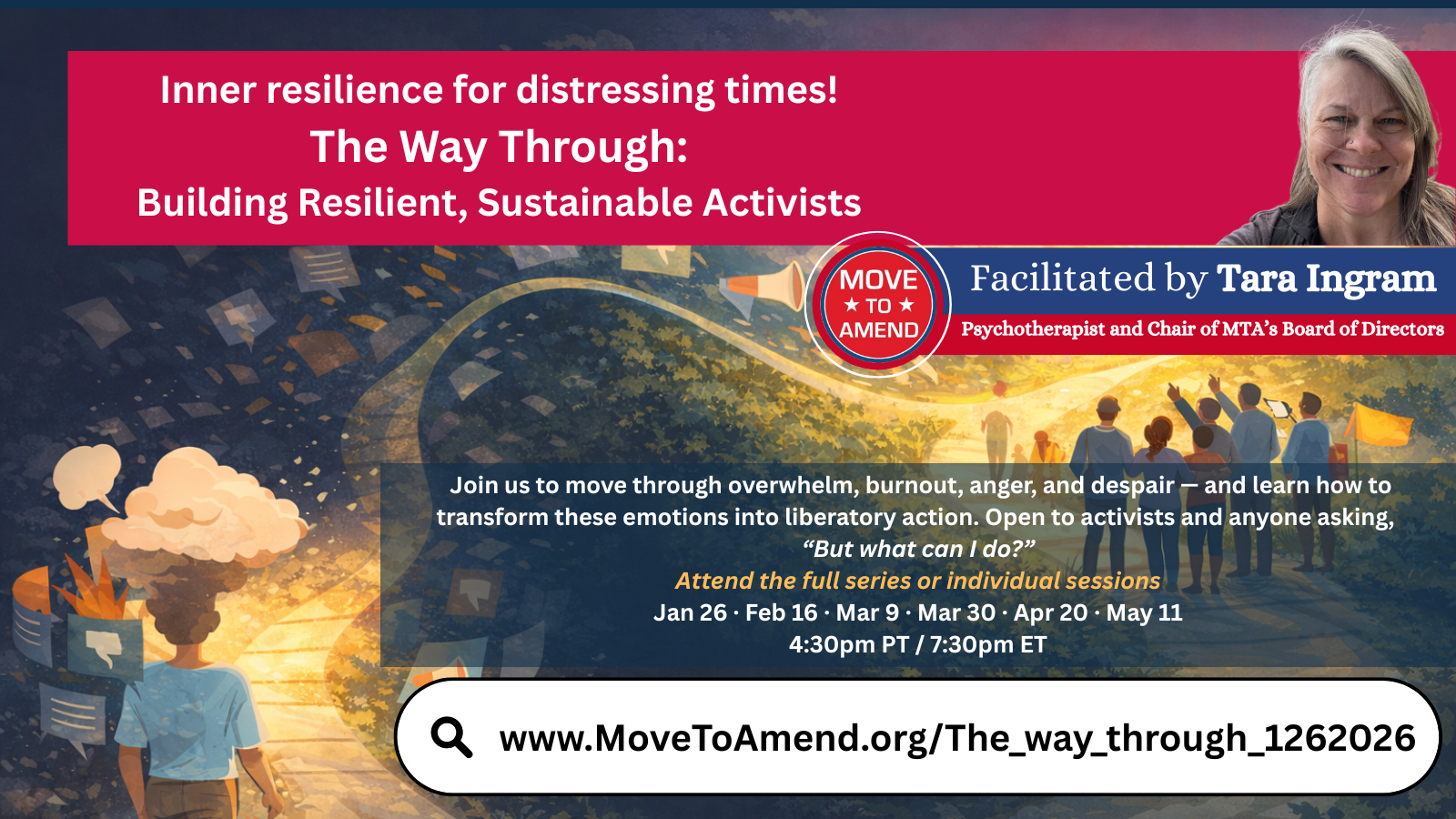
A 6-part series from Move to Amend’s Movement Education Program (MEP)
Read moreWTPW - Citizen's United 16th Anniversary
 |
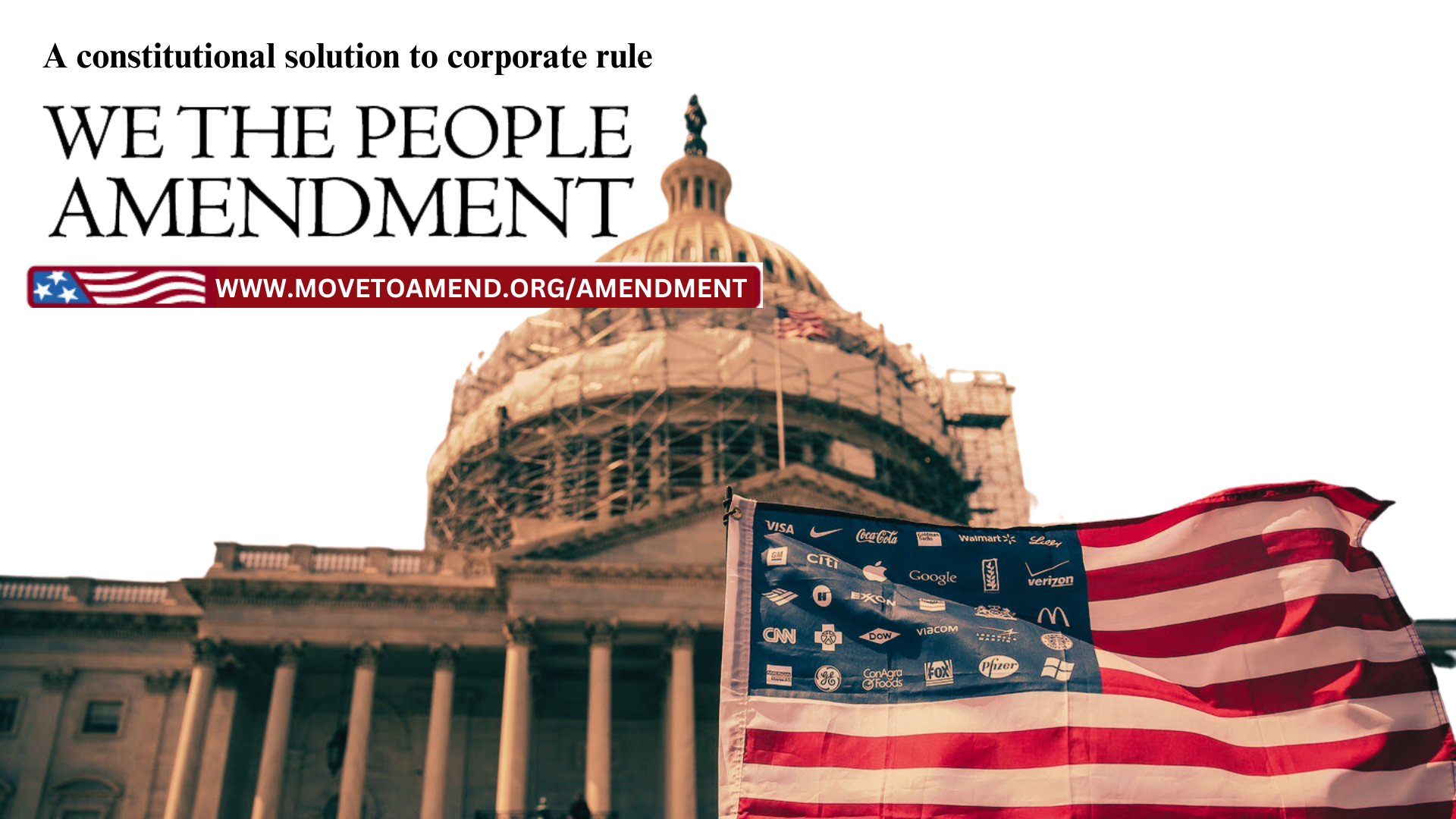
WE THE PEOPLE WEDNESDAYThe best time to overturn Citizens United was 16 years ago
The second best time is NOW |
|
|
Today, January 21, 2026 marks the 16th anniversary of Citizens United v. FEC, the Supreme Court decision that applied corporate personhood to campaign contributions and opened the floodgates to a new era of corruption. Many of the political crises we are facing today are the result of this decision being allowed to fester for 16 long years and a system where profit drives policy while public good is ignored. From economic inequality to environmental harm to immigration enforcement, corporate influence distorts decision-making and leaves communities to bear the consequences. This is exactly why the We the People Amendment (H.J.Res.54) is so critical. By overturning Citizens United, affirming that constitutional rights belong only to human beings, and allowing real limits on money in politics, this amendment addresses the root cause of so many interconnected injustices. Here's some easy steps how YOU can make a difference. |
|
You can take action right now using our OneClick Politics Tool to send an email to your local member of Congress Step 1: Go to our OneClick Politics page Step 2: Enter in your information to see your House Representative. You can check to see if they are a cosponsor HERE. Step 3: If you scroll down you will see a text box for the body of the email, feel free to edit as you see fit but we have drafted two sample messages for you If your Representative is NOT a cosponsor, please use Version 1 and delete Version 2 and the section headers for each If your Representative IS a cosponsor, please use Version 2 and delete Version 1 and the section headers for each Step 4: Proofread your email and send! It takes less than two minutes, and every message helps build the momentum we need. This is how we honor people harmed by systems built for profit. |
OTHER WAYS TO SUPPORT THIS MOVEMENT, MANY HANDS MAKE LIGHT WORK...Schedule a meeting with your Representative or Senator - Visit our Move the 119th Congress Campaign resources page for more information. Most meetings can be scheduled directly through your elected official's website, or you can email us at [email protected] - we’ll make it easy for you. Get involved in your community - Check here to see if there is already an MTA Affiliate Group in your area. If not, start one! Click here to volunteer or learn about becoming an advocate with Move to Amend! Make a donation - As you may imagine, being 100% grassroots funded is not easy. In order to survive and stand up to big money in politics, we need every resource we can get. Consider making a donation to Move to Amend to ensure this important work can continue. Attend an upcoming event with Move to Amend |
|
|
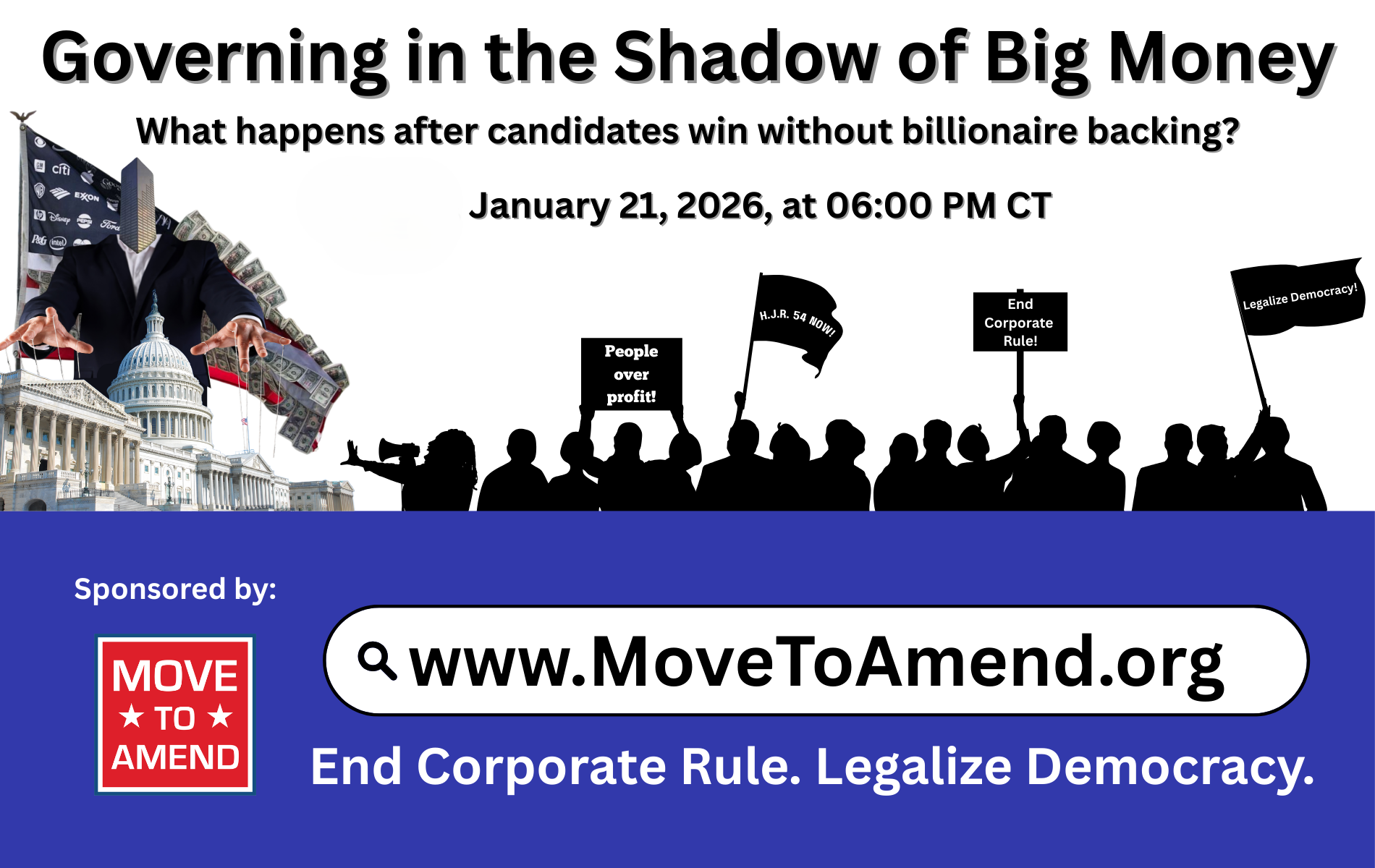
|
Together, we are turning the tide against Citizen's United and corporate rule. Thank you for being part of this movement. In solidarity, Alfonso, Greg, Jessica, Jason, Tara, Cole, Shelly, George, Daniel, Kelsey, Jennie, Keyan, Michael & Katie Move to Amend National Team
|

MTA 2025 Annual Report
The People’s Movement Our Future Depends On
As we reflect on 2025, one truth stands out clearly: this was not a normal year—and the challenges we face demand systemic solutions.
Across the country and around the world, people confronted deepening crises: unchecked corporate power, rising authoritarianism, accelerating climate devastation, economic precarity, and political systems increasingly unresponsive to the will of the people.
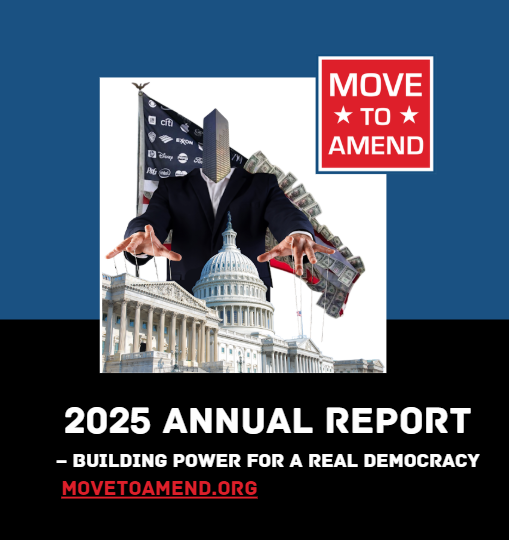
Today, we are happy to share our 2025 Annual Report: Building Power for a Real Democracy—the story of what you helped build
Read moreAffiliate and Advocate Spotlight - January 2026

Affiliate Spotlight: Miami County, Ohio
As the year came to a close, Move to Amend Miami County, Ohio offered a powerful reminder of what sustained, relational organizing looks like.
Read more