
How Move to Amend Stands Out from the Crowd
While it is exciting to see the flurry of momentum and energy that is finally getting some traction in a small segment of Congress, Move to Amend is very clear that it is important that we not let our goals be diluted by our legislators in Washington, even by those who mean well and want to see reform in our political system.
Passing an amendment will be a tough job, so the language must be commensurate with the effort needed to win, and the amendment must be strong and clear enough to end corporate rule - there's no room here for half solutions or ambiguity.
It is our belief that we need to operate on the assumption that once an Amendment comes out of Congress, we won't get another shot. So, we MUST get it right!
Click here to read Move to Amend's "We the People" Amendment proposal (House Joint Resolution 54) that will clearly establish that money is not speech, corporations are not people and allows for no loopholes. Our amendment will put people in charge of our government, and corporations in their proper place - subordinate to We the People.
With many competing proposals, it can be confusing to figure out what is what in terms of what the proposals will actually do. We have prepared a summary of each of the amendments proposed, including what is missing from each one.
We also encourage you to check out our article, "How Corporate Constitutional Rights Harm You, Your Family, Your Community, Your Environment, and Your Democracy" to explain why we feel so strongly that half-way solutions are insufficient.
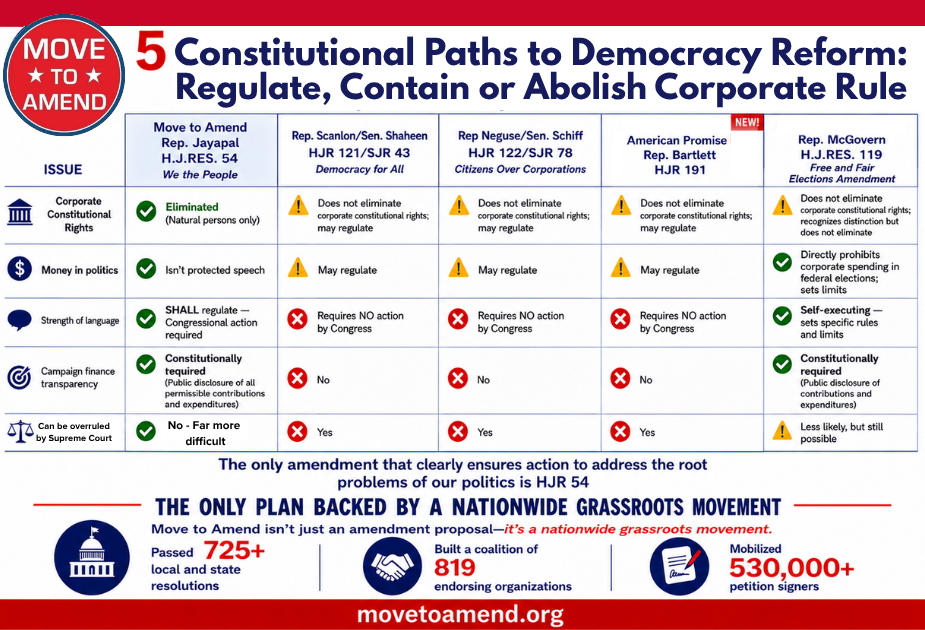
PROPOSED AMENDMENTS (119th Congress)
FIVE CONSTITUTIONAL PATHS TO DEMOCRACY REFORM
Why H.J.Res. 54 Provides the Most Comprehensive Structural Solution
Congress is considering five constitutional approaches to money in politics and corporate power. Each acknowledges a serious problem—but they differ fundamentally in what they would change, what they would require and what they would leave intact.
THE FUNDAMENTAL DIFFERENCE
Four proposals focus primarily on regulating political spending.
The We the People Amendment changes the constitutional framework that created corporate rule.
H.J.Res. 54:
- Affirms that constitutional rights belong to natural persons.
- Ends constitutional rights for corporations and other artificial entities.
- Declares that money spent to influence elections is not protected speech.
- Requires government action to prevent wealth from purchasing greater political influence.
- Requires public disclosure of permissible political spending.
- Applies to federal, state and local government.
WHY THE DETAILS MATTER
Citizens United v. FEC was not the beginning of corporate power. It was one decision in a century-long series of cases granting corporations constitutional rights and treating political spending as speech.
An amendment that regulates election spending while leaving those doctrines intact addresses a symptom without eliminating the constitutional foundation of the problem.
H.J.Res. 54 addresses both.
-
- Move to Amend's We The People Amendment introduced in the House of Representatives by Rep. Pramila Jayapal (WA) on February 12, 2025
- "Democracy for All" Amendment Proposal
- "Citizens Over Corporations" Amendment Proposal
- "Free and Fair Elections" Amendment Proposal
- American Promise -HJR191 - Amendment Proposal
"For our Freedom" Amendment Proposal
- Introduced on June 3, 2026, by Rep. Tom Barrett of Michigan
- Read summary, text and explanation: H.J. Res 191
- Organized supporters: American Promise
What it does:
- H.J.Res.191 restores authority to reasonably regulate election spending and permits lawmakers to distinguish corporations from natural persons, but it neither requires regulation nor ends corporate constitutional rights or the treatment of political spending as protected speech
What it is missing:
- Does not end corporate constitutional rights under the First, Fourth, Fifth, and Fourteenth Amendments.
- Does not end the treatment of political spending as protected speech under the First Amendment.
- Does not require Congress or the states to regulate political spending.
- Does not require public disclosure of political contributions and expenditures.
- Does not guarantee equal access to the political process regardless of economic status.
- Does not prevent wealthy interests from gaining substantially greater political influence through spending.
- Does not expressly grant local governments independent authority to regulate political spending.
- Does not specifically address candidates’ spending of their own money.
- Leaves courts to determine what constitutes “reasonable” regulation.
- Does not expressly protect freedom of the press.
H.J.Res.191/For Our Freedom authorizes Congress and the states to “reasonably” regulate election spending, but it neither requires them to act nor guarantees that any regulation will reduce the political power of corporations or concentrated wealth. It leaves intact corporate constitutional rights—including rights claimed under the First, Fourth, Fifth, and Fourteenth Amendments—and does not expressly overturn the treatment of political spending as protected First Amendment speech. The We the People Amendment addresses these doctrines at their source: it reserves constitutional rights for natural persons, directs courts not to treat election spending as protected speech, requires federal, state, and local governments to regulate political money, mandates public disclosure, and establishes political equality regardless of wealth as a constitutional standard.
"Democracy For All" Amendment Proposal
- Introduced on March 27, 2025 in the Senate by Sen. Jeanne Shaheen (NH) and on September 11, 2025 in the House of Representative by Rep. Mary Scanlon (PA)
- Read the summary, text and explanation: S.J. Res. 43 | H.J. Res. 121
- Organizational supporters: Public Citizen, People for the American Way, Free Speech for People, Common Cause, End Citizens United/Let America Vote Action Fund
What it does:
- Asserts that Congress and the States (a) may regulate and limit the raising and spending of money by candidates and others to influence elections, (b) may regulate and enact systems of public campaign financing, and (c) may distinguish between natural persons and corporations or other artificial entities
What’s missing:
- Does not end corporate constitutional rights under 1st, 4th, 5th, and 14th Amendments
- Does not end political money as protected speech under 1st Amendment
- Does not require Congress or the states to regulate political spending.
- Does not require public disclosure of political contributions and expenditures.
- Does not guarantee equal access to the political process regardless of economic status.
- Does not prevent wealthy interests from gaining substantially greater political influence through spending.
- Does not expressly grant local governments independent authority to regulate political spending.
- Does not specifically address candidates’ spending of their own money.
- Leaves courts to determine what constitutes “reasonable” limits.
See: Side-by-Side Comparison of HJR 54 and SJR 43
See: Side-by-Side Comparison of HJR 54 and HJR 121
Unlike the Democracy for All Amendment, the We the People Amendment does more than permit Congress and the states to set “reasonable” limits on political spending. It ends corporate constitutional rights—including rights claimed under the First, Fourth, Fifth, and Fourteenth Amendments—and directs courts not to treat political spending as protected speech under the First Amendment. It also requires federal, state, and local governments to regulate, limit, or prohibit contributions and expenditures, mandates public disclosure, and ensures equal access to the political process regardless of economic status.
"Citizens Over Corporations" Amendment Proposal
- Introduced on September 17, 2025 in the Senate by Sen. Adam Schiff (CA) and in the House of Representatives by Rep. Joe Neguse (CO)
- Read the summary, text and explanation: S.J. Res. 78 | H.J. Res. 122
- Organizational supporters: Democracy Defenders Action, Public Citizen, People for the American Way, End Citizens United/Let America Vote Action Fund
What it does:
- Asserts the authority of Congress and the States to regulate contributions and expenditures in political campaigns and to enact public financing systems for such campaigns.
What’s missing:
- Does not end corporate constitutional rights under 1st, 4th, 5th, and 14th Amendments
- Does not end political money as protected speech under 1st Amendment
- Does not require Congress or the states to regulate political spending.
- Does not require public disclosure of political contributions and expenditures.
- Does not guarantee equal access to the political process regardless of economic status.
- Does not require governments to prevent wealth from purchasing substantially greater political influence.
- Does not expressly include local governments in its regulatory authority.
- Makes public campaign financing optional rather than mandatory.
- Allows—but does not require—lawmakers to distinguish between natural persons and artificial entities or prohibit artificial-entity spending.
- Leaves courts to determine whether political-spending restrictions are “reasonable” and “viewpoint-neutral.”
See: Side-by-Side Comparison of HJR 54 and SJR 78
See: Side-by-Side Comparison of HJR 54 and HJR 122
Despite its name, the Citizens Over Corporations Amendment does not end corporate constitutional rights, including rights claimed under the First, Fourth, Fifth, and Fourteenth Amendments. It merely permits—but does not require—Congress and the states to distinguish artificial entities from natural persons or prohibit their election spending. The We the People Amendment establishes that constitutional rights belong exclusively to natural persons, requires regulation and public disclosure, rejects political spending as protected First Amendment speech, and prevents wealth from purchasing substantially greater access to or influence over elections.
Click here to read Move to Amend's proposed amendment that will clearly establish that money is not speech, a corporation is not a person, all corporations are subject to regulation, all campaign contributions will be disclosed and allows for no loopholes. Our amendment will put people in charge of our government, and corporations in their proper place.
CLICK HERE TO VIEW ANALYSIS OF 2023/2024 AMENDMENT PROPOSALS (118th Congress)
CLICK HERE TO VIEW ANALYSIS OF 2021/2022 AMENDMENT PROPOSALS (117th Congress)
CLICK HERE TO VIEW ANALYSIS OF 2019/2020 AMENDMENT PROPOSALS (116th Congress)
CLICK HERE TO VIEW ANALYSIS OF 2017/2018 AMENDMENT PROPOSALS (115th Congress)
CLICK HERE TO VIEW ANALYSIS OF 2015/2016 AMENDMENT PROPOSALS (114th Congress)
CLICK HERE TO VIEW ANALYSIS OF 2013/2014 AMENDMENT PROPOSALS (113th Congress)
CLICK HERE TO VIEW ANALYSIS OF 2011/2012 AMENDMENT PROPOSALS (112th Congress)

