
Home | News | Events
Check here for local news about corporate rule, Move to Amend press coverage, and announcements from the grassroots leaders of Ohio Move to Amend!
LTE: Where do candidates stand on corporate power?
Paula Hemmerick, volunteer with Move to Amend Miami County, Ohio had this LTE published in the Dayton Daily News on Oct. 4, 2026.
To the editor:
With hyperscale data centers moving into Ohio communities, often under nondisclosure agreements, voters may wonder: Where do candidates in the upcoming election stand on corporate power and big money in politics?
Move to Amend Miami County, Ohio surveyed 50 candidates in 20 races about their position on corporate power and money in politics. Specifically, the group contacted candidates for U.S. Senate; U.S. House Congressional Districts 4, 8, 10, and 15; Ohio Governor; Ohio Attorney General; Ohio Secretary of State; Ohio Senate District 5; and Ohio House Districts 36, 37, 38, 39, 40, 70, 71, 74, 80, 84, and 85.
The questionnaire asked candidates whether they would support amending the U.S. Constitution to make clear (1) corporations and other artificial entities do not have “constitutional” rights and (2) money spent on political campaigns is not protected speech and shall be regulated.
Twelve candidates pledged support for an amendment. Four candidates declined support. The remaining candidates did not respond despite repeated requests to participate.
Voters can see which candidates responded to the survey—and how they responded—by visiting https://www.movetoamend.org/pledge2025.
Move to Amend Miami County, Ohio is an affiliate of Move to Amend, a national, nonpartisan grassroots coalition working for a democracy in which our elected representatives are genuinely accountable to constituents, rather than large corporations and wealthy donors. Survey results are shared to inform voters of candidates’ position on corporate power and money in politics. Move to Amend neither endorses nor opposes any candidate for office.
Paula Hemmerick
Troy
LTE: Do voters know where candidates stand on corporate power?
On Oct. 3, 2026, team member Paula Hemmerick had this LTE published in Miami Valley Today
To the editor:
Do voters know where candidates stand on corporate power and big money in politics? As hyperscale data centers move into Ohio communities, this is an important question.
Move to Amend Miami County, Ohio surveyed 50 candidates in 20 races about their position on corporate power and money in politics. Specifically, the group contacted candidates for U.S. Senate; U.S. House Congressional Districts 4, 8, 10, and 15; Ohio Governor; Ohio Attorney General; Ohio Secretary of State; Ohio Senate District 5; Ohio House Districts 36, 37, 38, 39, 40, 70, 71, 74, 80, 84, and 85.
The questionnaire asked candidates whether they would support amending the U.S. Constitution to make clear (1) corporations and other artificial entities do not have “constitutional” rights and (2) money spent on political campaigns is not protected speech and shall be regulated.
Twelve candidates pledged to support an amendment to the Constitution. Their names, party affiliation, and office sought are: James Mills (L), Ohio Lt. Governor, running mate of Don Kissick; Allison Russo (D), Ohio Secretary of State; Vanessa Enoch (D), U.S. House 8; Kristina Knickerbocker (D), U.S. House 10; Don Leonard (D), U.S. House 15; Desire Tims (D), Ohio House 38; Daquan Neal, (D), Ohio House 39; Timothy Hornbacker (D), Ohio House 40; Kim McCarthy (D), Ohio House 70; Katie Koehler Wagner (D), Ohio House 80; Arienne C. Childrey (D), Ohio House 84; and Victoria Maddox (D), Ohio House 85. Jeffrey Harris (D), running for Ohio Senate 5, had expressed support in 2025.
Four candidates declined support. They were Don Kissick (L), Ohio Governor; Tom Pruss (L), Ohio Secretary of State; Bill Redpath (L), U.S. Senate; and Brennan Jacob Barrington (L), U.S. House District 15. Responses from Kissick, Pruss, and Barrington were nuanced and can be reviewed at https://www.movetoamend.org/pledge2025.
The remaining candidates did not respond to repeated requests to participate in the survey, including Vivek Ramaswamy and Amy Acton in the gubernatorial race and Bernie Moreno and Sherrod Brown in the U.S. Senate race.
Move to Amend Miami County, Ohio is an affiliate of Move to Amend, a national, nonpartisan grassroots coalition working for a democracy in which our elected representatives are genuinely accountable to constituents, rather than large corporations and wealthy donors. Survey results are shared to inform voters of candidates’ position on corporate power and money in politics. Move to Amend neither endorses nor opposes any candidate for office.
Paula Hemmerick,
Troy
Ending coin-operated democracy requires constitutional amendment
By Deb Hogshead
Guest columnist
Published in local newspaper, Miami Valley Today, on July 7
"Together, we must restore the essence of democracy envisioned by the Founders by reevaluating the relationship between wealth and politics. A revolutionary overhaul of campaign finance laws is crucial. Public financing of elections, greater transparency in political donations, and prohibiting the use of 'dark money' … are critical."
—Chris Gibbs
In his June 20 column, Chris Gibbs did a great job describing our pay-to-play system of government and the steps needed to make sure our elected representatives are genuinely accountable to we the people, rather than to the wealthy donor class and mammoth corporations.
I agree.
To make his suggested solutions stick and prevail when challenged in court, however, we must amend the U.S. Constitution.
Foundational to the change we need is the We the People Amendment, House Joint Resolution 54 in the current Congress. This proposed amendment will make two things clear: (1) money spent on political campaigns is not protected speech and shall be regulated at all levels of government, and (2) inherent, inalienable rights belong to natural persons only, not to corporate entities created through a state chartering process.
Without this amendment, new campaign finance laws could very well be struck down as “unconstitutional.” The Supreme Court ruled in 1976 that money spent on political campaign messages is protected speech (Buckley v. Valeo). In 2010, it struck down part of the 2002 McCain-Feingold Act, giving rise to Super PACs and flooding even more money into political campaigns (Citizens United v. Federal Election Commission). Then on June 30 of this year, the court struck down a post-Watergate law limiting fundraising and spending by political parties (National Republican Senatorial Committee v. Federal Election Commission).
But it’s not just money in politics that should concern us. Over the years, the Supreme Court has granted corporate entities constitutional rights, rights that should be reserved for natural persons only. Besides ruling that a corporation has a 1st Amendment right to influence elections, the court has also decided a corporation has a 1st Amendment right to NOT speak, that is, to hide information it doesn’t want to share; a 4th Amendment right to refuse surprise public health inspections without a warrant; a 5th Amendment right to sue for future profits lost if a municipality places restrictions on its business; and a 14th Amendment right to equal protection under the law.
With these so-called “constitutional” rights, a large corporation, with lots of money and the best lawyers, can make a lot trouble for local communities trying to protect public welfare, but lacking the financial resources to do battle in court.
Yes, of course, a corporation should have privileges, protections from government overreach, and statutory rights. As a creation of the state, however, a corporation should never have inherent, inalienable “constitutional” rights same as you and me.
For folks who say it’s too hard and takes too long to pass a constitutional amendment, consider the following.
We can take interim steps. For example, the Transparent Election Initiative (aka, the Montana Plan), is a citizen ballot measure that, when passed, will curb corporate political spending through a change in state law that creates corporations. Hawaii did this recently through a bill passed in the state legislature and signed by the governor. In 2024, Maine voters passed a ballot initiative banning Super PACs. All are critical interim steps, but they don’t address all the challenges associated with money in politics and so-called corporate constitutional rights. And they’re already being challenged in court.
It’s also important to remember that just because something is hard, or takes a long time, doesn’t mean it’s impossible or unworthy of our attention and effort. We all sit in the shade of a tree we didn’t plant. It took 72 years to ratify the 19th Amendment, which gave women the right to vote. It took more than 200 years to pass the 27th Amendment, which stipulates that increases in congressional pay cannot be implemented until after the next election of House members.
Let’s work for the changes Chris recommends. And let’s ensure they’re permanent by getting the We the People Amendment passed in both chambers of Congress and ratified by 38 states.
The writer is a Troy resident and a volunteer with Move to Amend Miami County.
Statement Supporting Area Residents Concerned about Proposed Data Centers
By Move to Amend Miami County, Ohio and published in our local paper, Miami Valley Today, July 4, 2026
Move to Amend Miami County stands with Piqua and Sidney residents concerned about the consequences of the proposed data centers in their communities.
Move to Amend works to restore government to the people, beyond control of big business, through an amendment to the U.S. Constitution that ends corporate personhood and states that money is not free speech.
Move to Amend believes the following principles should guide each and every one of us:
• A clean environment should be a human right.
• A business should not have the freedom to pollute the environment, but should be expected to take every precaution to protect the environment and human health and to clean up that which it has spoiled.
• Citizens should have not only the right, but the power if in the majority, to decide conditions that protect and promote the health, safety and welfare of themselves and the larger community.
• A corporation of any kind, which is created through a chartering process, should not have inherent, inalienable constitutional rights the same as area citizens.
The U.S. Supreme Court has ruled that spending money is free speech and that corporations have a 1st Amendment right to speak. Big tech companies have lots of money. They use their “constitutional” right to spend it to influence government decisions that limit regulation and allow the fast-tracking of approvals.
Listed below are a few big-tech spending figures based on information publicly available through OpenSecrets.org:
• $33,333,888 – Total contributions in 2024 to federal candidates, made by individuals and affiliates associated with Amazon, Microsoft, Palantir Technologies, and Meta. (OpenSecrets.org gave no information for Alphabet Inc., Google’s parent company.)
• $2,571,866 – Total contributions during the 2023-2024 election cycle, from political action committees for Amazon, Microsoft, Palantir Technologies, Meta, and Alphabet.
• $57,925,000 – Total spent in 2025 on lobbying Congress, by Amazon, Microsoft, Palantir, Meta, and Alphabet.
Nondisclosure agreements are another tool used by corporations. The details of the proposed Piqua and Sidney data centers were protected by nondisclosure agreements. It is also conceivable that a data center, like any other corporate entity, could claim other constitutional rights, such as a 4th Amendment right to refuse a surprise environmental inspection without a warrant, or a 1st Amendment right to not speak, to not share with community residents information it considers proprietary.
Data centers can ruin our quality of life by consuming enormous amounts of water and energy, resulting in higher costs for area residents and environmental damage. Data center development is good for big business, but not for area citizens.
We, the residents of Miami and Shelby counties, are unfairly being expected to live with the environmental and financial consequences of data center construction and use.
Move to Amend Miami County stands in solidarity with Piqua and Sidney residents seeking transparency, accountability, and a safe, livable environment.
Move to Amend Miami County, Ohio is an affiliate of the national grassroots coalition known as Move to Amend. Learn more at www.movetoamend.org, or contact Move to Amend Miami County at [email protected].
View online at https://miamivalleytoday.com/statement-supporting-area-residents-concerned-about-proposed-data-centers/
Why Cleveland Heights residents say civic participation matters more than ever
Residents gather at Cleveland Heights City Hall for the city's 13th annual Democracy Day hearing, sharing perspectives on voting rights, campaign finance, environmental protections and the future of democratic institutions.
Updated: Jun. 15, 2026, Published: Jun. 09, 2026
By Chris Pugh, cleveland.com | Advance Local Express Desk
https://docs.google.com/document/d/17f4J1S2NdJ3pLHzO6Dwhu-lHfEGZXNQj9XVVwtg_zAM/edit?tab=t.0
CLEVELAND HEIGHTS, Ohio - Residents voiced concerns about corporate influence in politics, environmental protections, voting rights, and the future of democratic institutions during Cleveland Heights’ 13th annual Democracy Day hearing.
The hearing, held Monday as part of the city’s longstanding observance of Democracy Day, invited residents to share their views on the state of American democracy and discuss reforms they believe are needed to strengthen democratic participation.
Read moreMove to Amend Miami County, Ohio Presents History Lesson to Troy City Council
Local MTA Affiliate Addresses Troy, Ohio City Council
At the June 15th Troy City Council meeting, volunteers with Move to Amend Miami County, Ohio provided a history lesson in advance of the nation's 250th birthday. Our founders, imperfect though they were, understood the threat to democracy posed by wealthy factions and corporations. They took turns reading quotations from our founders and early presidents.
Scroll down to read the script the team used for this effective presentation.
JUNE 15, 2026: STATEMENTS TO TROY CITY COUNCIL ON NATION’S 250TH BIRTHDAY
PREFACE: volunteer
[Holding up a $5 bill] This is money, not speech. It’s property I possess.
[Holding up a corporate charter for FirstEnergy Corp] This is a corporate charter, not a person. It’s property shareholders own.
Billionaires and large corporations use their property to influence decisions that affect us, often in harmful ways. That’s why we need to end the misguided doctrines that “money is speech” and “a corporation is a person” with inherent, unalienable “constitutional” rights. This need is neither new nor radical. In fact, our nation’s founders, however imperfect they were, understood the threats posed by wealthy factions and corporations. Tonight, in honor of our nation’s 250th birthday, we will share what founders and early presidents had to say about these threats to democracy.
Quote 1: volunteer
I’m reading a statement made by Gouverneur Morris, in 1787, at the Constitutional Convention.
The Executive Magistrate should be the guardian of the people, even of the lower classes, [against] Legislative tyranny, against the Great & the wealthy who in the course of things will necessarily compose the Legislative body. Wealth tends to corrupt the mind & to nourish its love of power, and to stimulate it to oppression. History proves this to be the spirit of the opulent.
Quote 2: volunteer
I’m reading a statement by James Madison, 1792, writing anonymously for the National Gazette.
A government operating by corrupt influence; substituting the motive of private interest in place of public duty; converting its pecuniary dispensations into bounties to favorites, or bribes to opponents; accommodating its measures to the avidity of a part of the nation instead of the benefit of the whole: in a word, enlisting an army of interested partisans, whose tongues, whose pens, whose intrigues, and whose active combinations, by supplying the terror of the sword, may support a real domination of the few, under an apparent liberty of the many.
Quote 3: volunteer
I’m reading a statement from George Washington’s 1796 Farewell Address.
However combinations or associations . . . may now and then answer popular ends, they are likely, in the course of time and things, to become potent engines by which cunning, ambitious, and unprincipled men will be enabled to subvert the power of the people and to usurp for themselves the reins of government, destroying afterwards the very engines which have lifted them to unjust dominion.
Quote 4: volunteer
I’m reading a statement Thomas Jefferson wrote, in 1796, to Edward Rutledge, youngest signer of the Declaration of Independence, a wealthy South Carolina lawyer, and politician who became governor of that state.
I love to see honest men & honorable men at the helm, men who will not bend their politics to their purses, nor pursue measures by which they may profit, & then profit by their measures.
Quote 5: volunteer
I’m reading a statement Thomas Jefferson wrote, in 1816, in a letter to George Logan, a Pennsylvania politician, farmer and friend.
I hope we shall . . . crush in [its] birth the aristocracy of our monied corporations which dare already to challenge our government to a trial of strength and bid defiance to the laws of our country.
Quote 6: volunteer
I’m reading a statement made by James Madison, in1827, to J.K. Paulding, a Navy agent who later became U.S. Secretary of the Navy.
[I]ncorporated Companies with proper limitations and guards, may in particular cases, be useful; but they are at best a necessary evil only.
Quote 7: volunteer
In his 1833 message to Congress, Andrew Jackson, 7th president of the United States, excoriated the Second Bank of the United States, one of the largest corporations at the time, describing it as "a permanent electioneering engine" and calling for the revocation of its charter, which it had violated.
Here’s what else he had to say:
. . . the question is distinctly presented whether the people of the United States are to govern through representatives chosen by their unbiased suffrages or whether the money and power of a great corporation are to be secretly exerted to influence their judgment and control their decisions.
Quote 8: volunteer
In his 1837 First Annual Message, Martin Van Buren, 8th president of the United States, 1837, also addressed concerns about the corporate banking system in the United States. Here’s what he had to say:
[T]here will be neither stability nor safety either in the fiscal affairs of the Government or in the pecuniary transactions of individuals and corporations so long as a connection exists between them which, like the past, offers such strong inducements to make them the subjects of political agitation. Indeed, I am more than ever convinced of the dangers to which the free and unbiased exercise of political opinion—the only sure foundation and safeguard of republican government—would be exposed by any further increase of the already overgrown influence of corporate authorities.
Quotes 9 & 10: volunteer
There’s a bright line that extends from our founders up through the ages. I'd like to read two more quotations. They come 112 and 134 years, respectively, after our founding; however, they are consistent with our founders’ warnings and are worth sharing now.
In his 1888 annual message, Grover Cleveland said,
Corporations, which should be the carefully restrained creatures of the law and the servants of the people, are fast becoming the people's masters.
Theodore Roosevelt had this to say in his 1910 New Nationalism Speech:
The true friend of property, the true conservative, is he who insists that property shall be the servant and not the master of the commonwealth; who insists that the creature of man’s making shall be the servant and not the master of the man who made it. The citizens of the United States must effectively control the mighty commercial forces which they have called into being.
CONCLUDING COMMENT: volunteer
Eleven years after the Declaration of Independence, our founders crafted the U.S. Constitution. They built into the Constitution a process for amending it, which has been done 27 times. It’s time to do it again with the proposed We the People Amendment, House Joint Resolution 54 in the current Congress. The survival of our democratic republic requires the regulation of political spending to ensure that everyone—not just those with the most money—has a voice in decisions that affect us. It is also essential that we make clear, once and for all, that a corporation, as a creation of the state, is not a person with inherent, inalienable constitutional rights. Move to Amend will continue to educate Miami County residents about the need to eliminate these very threats identified years ago by our founders and early presidents.
2026 Cleveland Heights Democracy Day
Council Chambers, Cleveland Heights (Ohio) City Hall
June 4, 2026

https://www.youtube.com/watch?v=_vkowR5ZiyQ&t=63s
A Summary of Subjects and Themes Addressed
- US House Joint Resolution 54, the We The People Amendment to the US Constitution, has 75 cosponsors. It becomes more relevant and essential every day as the US now faces the prospect of personhood for Artificially Intelligent bots.
- Hyperscale data center threats include exponential increases in local communities' electric bills and wastewater contamination with PFAS and other "forever chemicals."
- Recent New York Times coverage of Buckley v. Valeo and Bloomberg Law coverage of an ACLU lawsuit in which the judge upheld the actual votes of corporations and other "artificial entities" in a 2024 Fenwick, Delaware election.
- As poverty continues to increase, Americans have a responsibility to speak out against inequality and to vote.
- Corporations claiming first amendment rights and the Supreme Court classifying money as a form of "speech" has led to the destruction of water-purifying wetlands and poisonous algal blooms in Lake Erie, among many other environmental harms.
- The advantages of paying taxes confers myriad benefits on individuals and communities, including public schools, public libraries, trash collection, functioning roads, bridges and sewer systems, and many others.
-
Song performed with ukulele accompaniment: "Corporations Are Human," © Tom Neilson.
- Selected portions of President George Washington's Farewell Address were quoted, including: "The basis of our political systems is the right of the people to make and to alter their constitutions of government. But the Constitution which at any time exists, till changed by an explicit and authentic act of the whole people, is sacredly obligatory upon all."
- A member of Showing Up for Racial Justice (SURJ) explained that SURJ organizes white people to join the battle against white supremacy, and stressed that white people also have much to gain in fighting to end racism.
- A recent trip to England, including a viewing of the Magna Carta, inspired one Cleveland Heights resident to an even greater appreciation of the Statue of Liberty and its timeless words "Give me your tired, your poor, Your huddled masses yearning to breathe free..."
- Song performed with guitar accompaniment: "How We Can Sleep at Night," © 2011 Lou & Peter Berryman
- A member of Healthcare for all Ohioans detailed several of the ways that rather than Healthcare for all Americans, we have healthcare as social murder.
- The speaker posits that debt-based money endangers democratic governance. He supports the American Monetary Reform Act of 2026, which would improve and stabilize the Nation’s economy by restoring Congress’s power to create and regulate money.
- "Happy 250th Birthday, America. What's Next?" To create a functioning democracy, Congress must use its constitutionally granted power to change the Supreme Court.
- Recent local issues illustrate the need for democratic action at the local level: the sudden, secret closure of the Cleveland State University radio station; the Heights Libraries' dismantling of the arts center in the former Coventry School; and NEORSD's actions to turn Horseshoe Lake and Lower Lake into wetland areas.
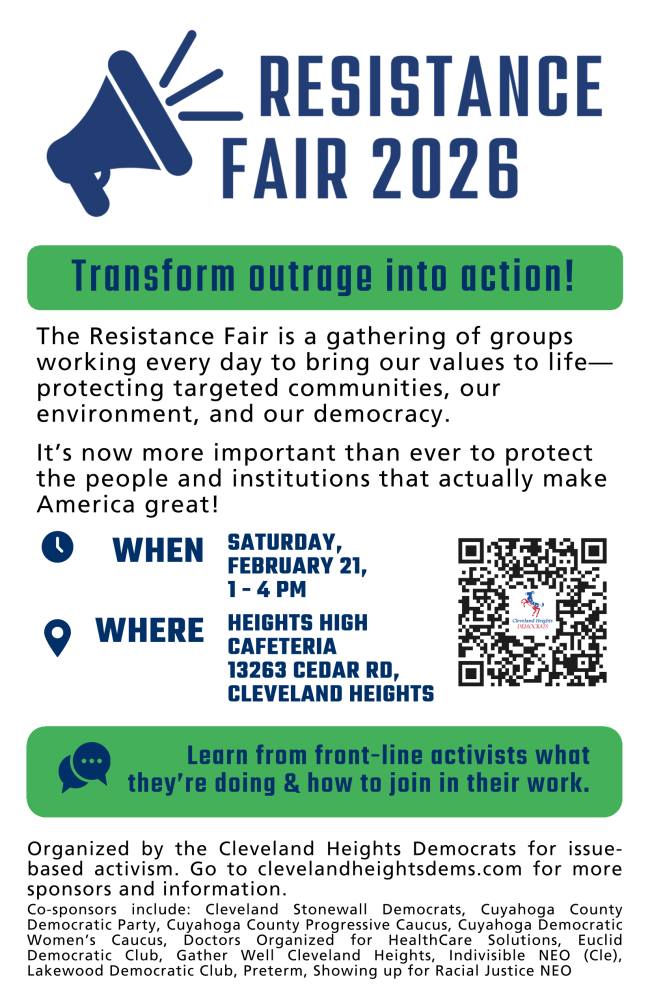
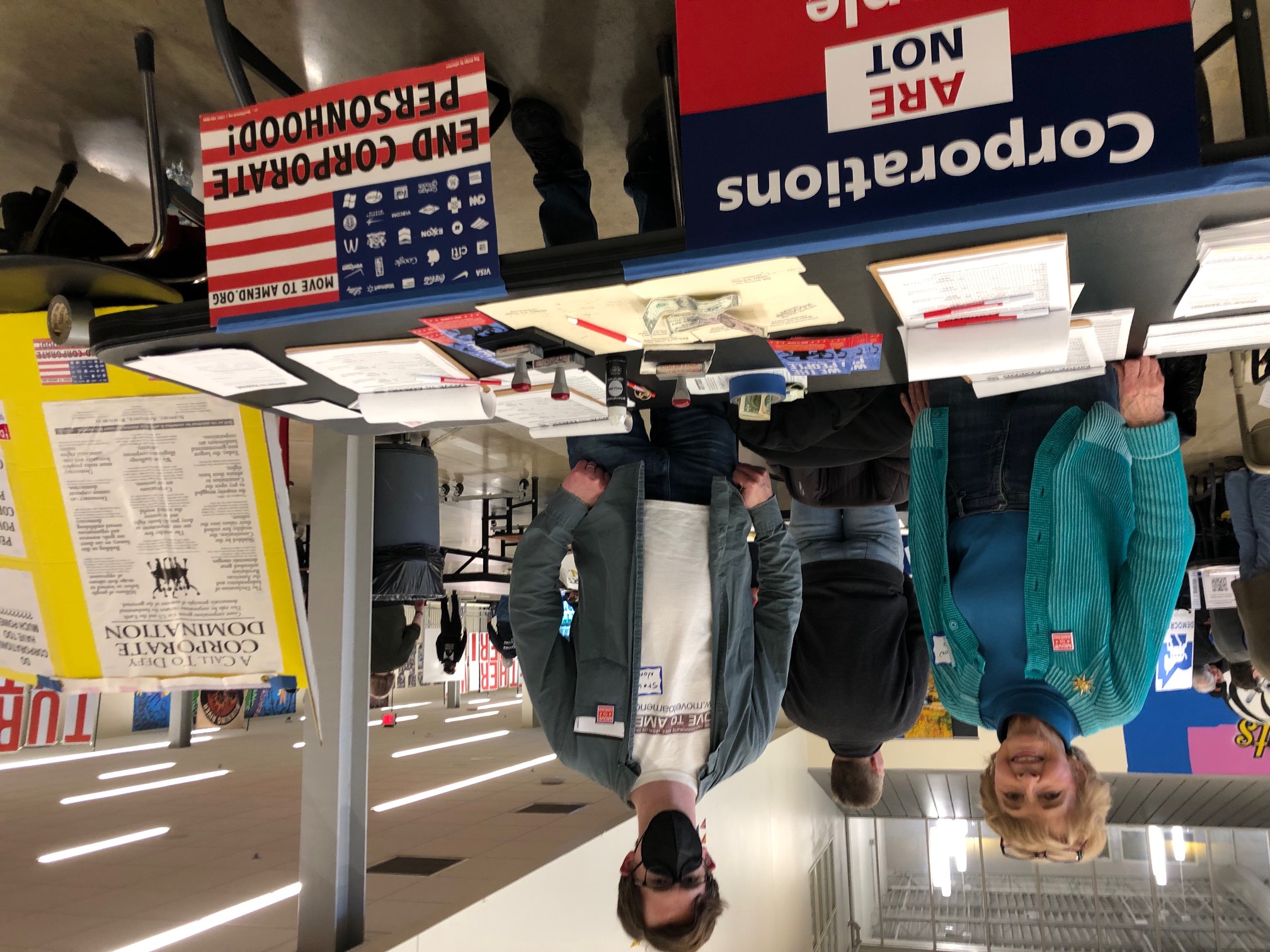
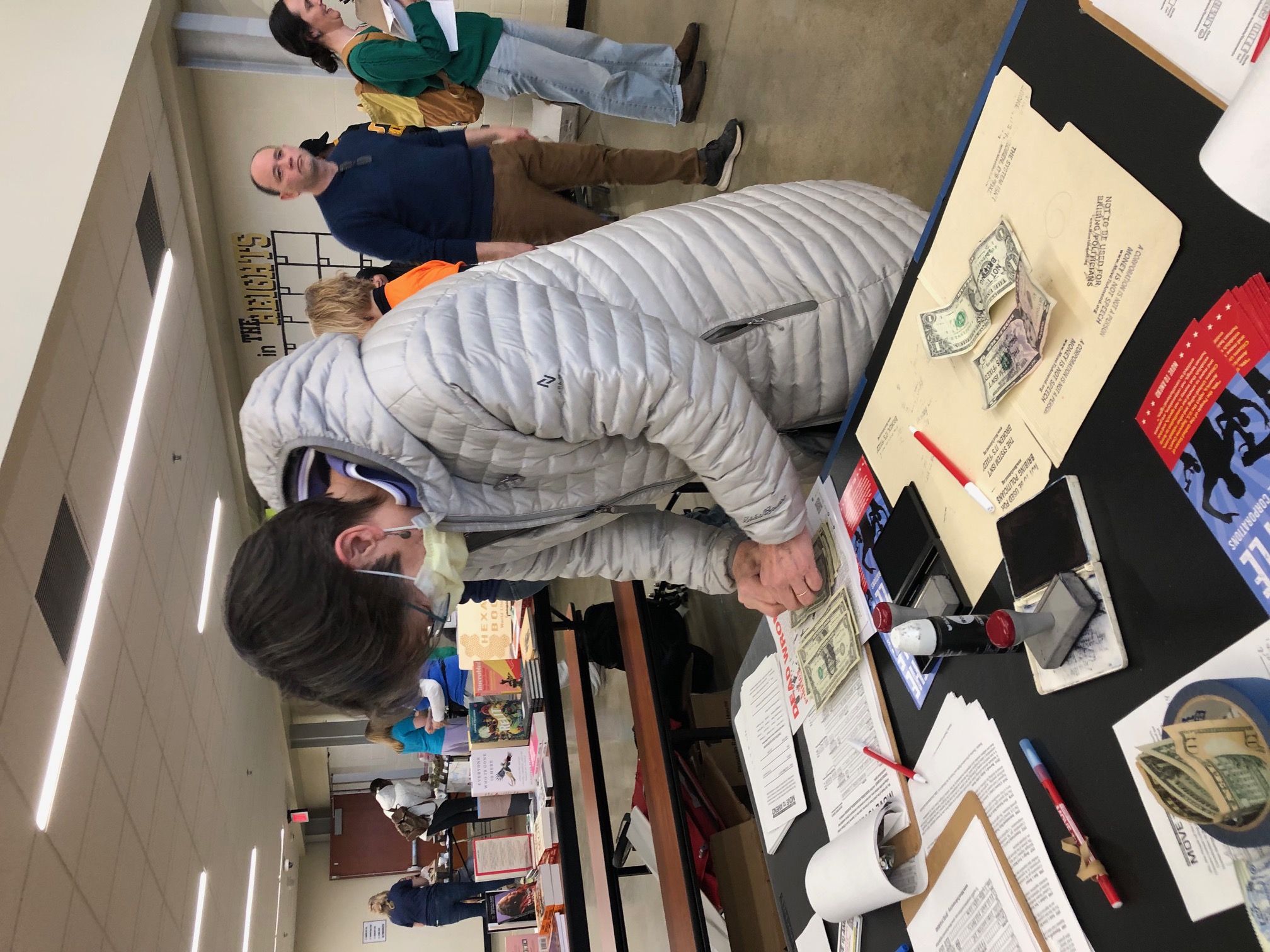
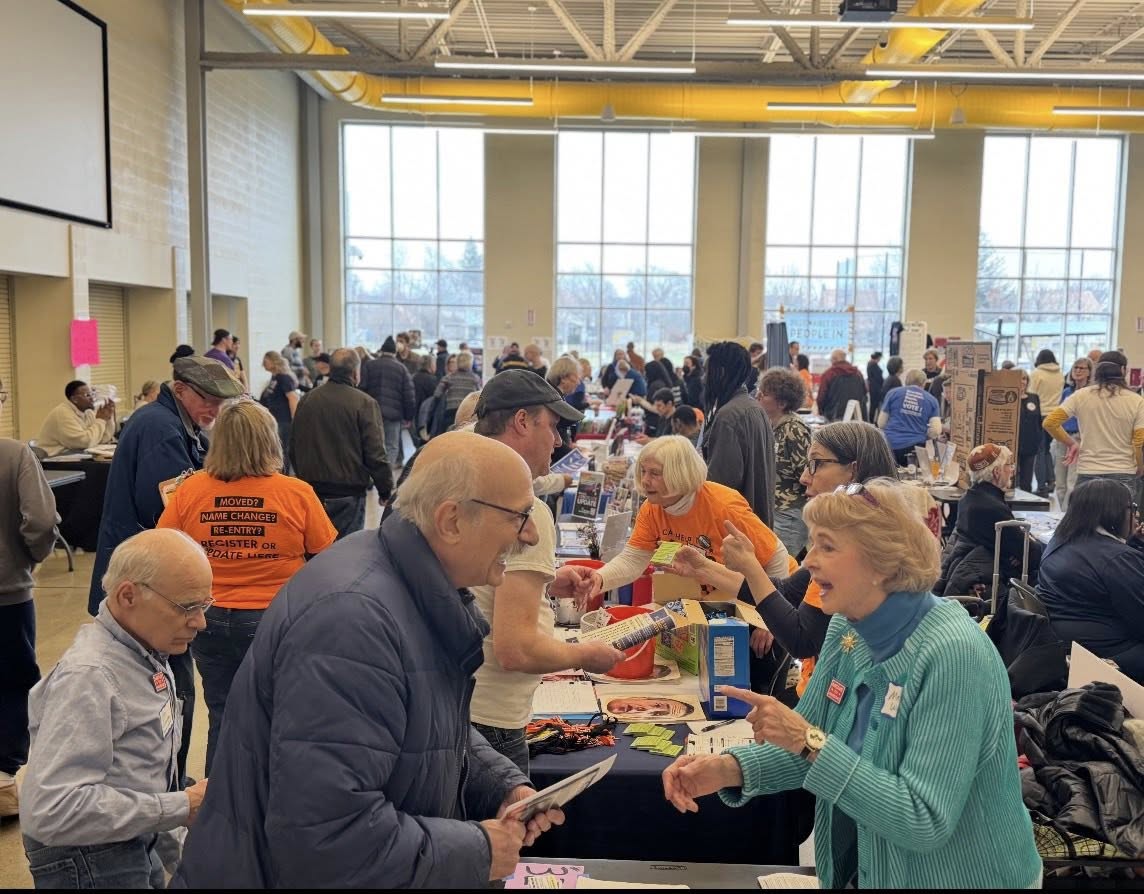
[OHIO] Cleveland Hts Resistance Fair 2026
Data Center Proliferation Exposes Constitutional Problem
By Deb Hogshead
Guest Column in Miami Valley Today, January 18, 2026
The proposed data center in Piqua brings home an important fact: Corporate power and big money affect us locally—and a local response is necessary to help rein in their influence over issues that affect us directly and indirectly.
Like folks in other Ohio communities, including Sidney, Piqua residents raised objections upon learning of plans to build a data center in their hometown. Among their concerns, which I share, are threats to the environment and limited water resources, and questionable promises of economic development and stable residential electric bills. But the deal was already done, slid secretly into the community under a nondisclosure agreement.
Nondisclosure agreements are just one tool in the tech industry’s tool box.
As true of any large corporate entity, big tech companies have lots of money and a “constitutional” right to spend it—and they spend it to garner support in Congress and state legislatures for such things as limited regulation and the fast-tracking of approvals.
Big Tech can do this thanks to the U.S. Supreme Court. Since 1886 and the Santa Clara County v. Southern Pacific Railroad decision, the court has considered a corporation a person with constitutional rights. In 1976, the court ruled in Buckley v. Valeo that spending money on campaign communications is equivalent to 1st Amendment protected speech. In 1978, it ruled in First National Bank of Boston v. Bellotti that a corporation has a 1st Amendment right to influence an election. More recently, the court’s 2010 decision in Citizens United v. Federal Election Commission led to the rise of Super PACs and even more money flowing into politics, often from unnamed donors.
I list below a few figures based on information publicly available through OpenSecrets.org.
$33,333,888 – Total contributions in 2024 to federal candidates, made by individuals and affiliates associated with Amazon, Microsoft, Palantir Technologies, and Meta. (OpenSecrets.org gave no information for Alphabet Inc., Google’s parent company.)
$2,571,866 – Total contributions during the 2023-2024 election cycle, from political action committees for Amazon, Microsoft, Palantir Technologies, Meta, and Alphabet.
$57,925,000 – Total spent in 2025 on lobbying Congress, by Amazon, Microsoft, Palantir, Meta, and Alphabet.
These same companies pay lobbyists to influence Ohio legislators and executives. According to the Ohio Lobbying Activity Center, Amazon currently has 7 registered lobbyists, Microsoft has 1, Meta 13, and Google 18. They are joined by lobbyists representing groups such as the Ohio Business Roundtable, which wants to streamline the permitting process for data centers, and Americans for Prosperity (AFP) Ohio and the Buckeye Institute, both of which want fewer permit restrictions.
Public opposition to the proliferation of data centers has grown. So has awareness of our power grid’s limitations and the need to upgrade at considerable expense. In July 2025, the Public Utilities Commission of Ohio (PUCO) ruled those costs should be borne by the companies that own the data centers, as opposed to expecting small businesses and ordinary ratepayers to pick up the tab. The tech industry has objected, given the investments companies have already made in Ohio. Sharing this discontent is the Ohio Manufacturers’ Association, whose lawyers have appealed to the Ohio Supreme Court, claiming the ruling amounts to discrimination against certain types of utility customers.
Discriminating against a person based on race, sex, and other immutable characteristics is wrong and illegal. A corporation, however, is not a person. And a big corporation that poses risks to the quality of life in our local communities should be discriminated against, or at least held to higher expectations.
I’m not saying Big Tech (or any corporate entity) shouldn’t have a voice. Nor am I saying a big tech company shouldn’t have privileges, “statutory” rights, and protection from government overreach. What I am saying is Big Tech’s voice should never be louder than ours or carry greater weight with our representatives. And a corporation of any kind, which is created on paper through a chartering process, should not have inherent, inalienable constitutional rights same as you and me.
If we are to regulate money in politics and end the misguided doctrine of “corporate constitutional rights,” we must pass the proposed We the People Amendment, House Joint Resolution 54 in the current Congress.
January 21 is the 16th anniversary of the Citizens United decision. Use this day to call Reps. Mike Carey and Warren Davidson and urge them to cosponsor the We the People Amendment.
And encourage your local elected officials to go on record in support of the We the People Amendment. Given what’s happening with data centers across Ohio, municipal leaders cannot defend inaction by saying money in politics and corporate power are not relevant to their work as public servants.
An Independence Day call to dethrone today’s kings
By Deb Hogshead, guest columnist
If there was anything I knew as a kid about the American Revolution it was that we toppled a king. I always took pride in this fact because I have ancestors on both sides of my family who fought in the war. One of them, Isaiah Hoskinson (1749-1836), is buried in the Hupp-Hoskinson Cemetery in Licking County.
At least three veterans of the Revolutionary War are buried here in Miami County at Troy’s Rose Hill Cemetery: John W. Meredith (1761-1844), Alexander Telford (1760-1844), and Aaron Tullis (1751-1840).
These four men were either teenagers or in their mid-20s when the Declaration of Independence was signed. I know little else about them beyond a general understanding of the principles for which they fought—and for which an estimated 25,000 died.
“We hold these truths to be self-evident, that all men are created equal, that they are endowed by their Creator with certain unalienable Rights, that among these are Life, Liberty and the pursuit of Happiness.” So begins the first line of the second paragraph of the Declaration of Independence.
To justify separation from Great Britain, our founding document lists 27 specific examples of abuses perpetrated by King George III. Listed as the first grievance, “He has refused his Assent to [approval of] Laws, the most wholesome and necessary for the public good.” Here are just a few others:
• “He has erected a multitude of New Offices, and sent hither swarms of Officers to harrass [sic] our people, and eat out their substance”
• “For depriving us in many cases, of the benefits of Trial by Jury”
• “For taking away our Charters, abolishing our most valuable Laws, and altering fundamentally the Forms of our Governments”
Where are we now, 249 years later? Are we once again living under a king?
Democrat or Republican, a president is not a king. The current administration, however, is acting like one, and the majority in Congress seems to be abdicating its constitutional duty to be a check on the executive branch. But even after the President leaves office, kings will remain. These other kings have been at work for well over 100 years, thanks to a series of U.S. Supreme Court cases that have given them constitutional advantages over the rest of us. I’m speaking of the ultra-wealthy and large corporations, the power brokers with the big money to influence elections and the decisions of the elected—decisions about issues such as funding for public education, access to healthcare, protection of the environment and public health, corporate use of public lands, and the privatization of government services. Their agendas put profits over the most wholesome laws necessary for the public good. Ending their rule requires us to do something revolutionary.
By revolutionary I don’t mean war. I mean a dramatic change to the U.S. Constitution, a change that embodies its aspirational preamble, which opens with the words “We the People.”
As the Declaration of Independence states, governments derive “their just powers from the consent of the governed,” and the people have the right to alter it, “laying its foundation on such principles and organizing its powers in such form, as to them shall seem most likely to effect their Safety and Happiness.”
If we are to have a government of, by, and for the people—as opposed to a government of, by, and for the ultra-wealthy and large corporations—we must amend the Constitution, adopting and putting into practice two additional guiding principles: a corporation is not a person with unalienable, constitutional rights, and money spent on political campaigns is not free speech and shall be regulated.
It’s time to topple the kings of today with a constitutional amendment. I can’t think of a better way to honor Isaiah, John, Alexander, Aaron, and all those who made our nation possible.
The writer is a Troy resident and a volunteer with Move to Amend Miami County.

