
Cultural Change for the We the People Amendment
tenth in the series
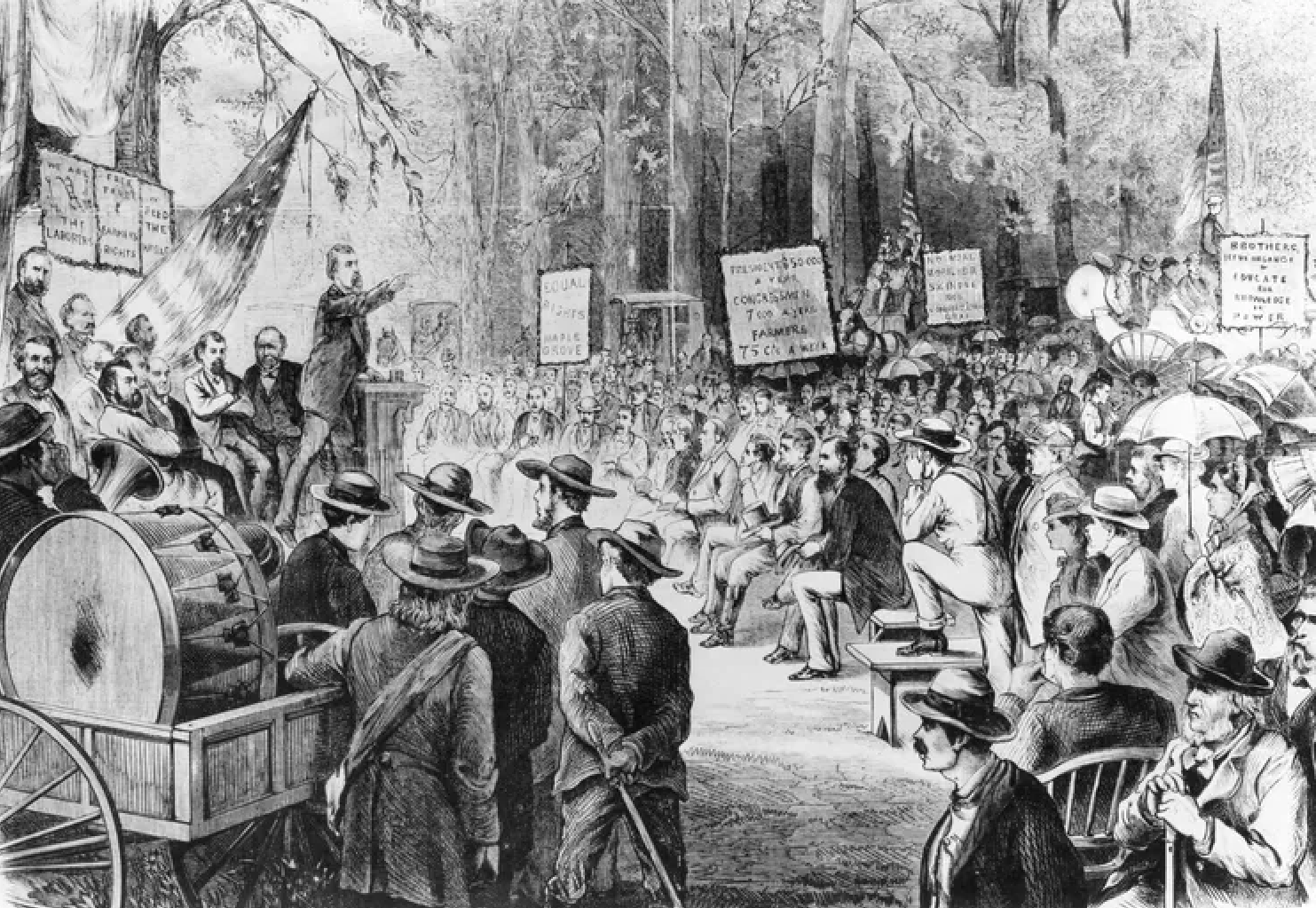
The Populist movement of the late 19th century was the largest democratic mass movement in U.S. history. The movement included several parallel but independent organizations of farmers in the South, Midwest and High Plains. The movement later included urban working people across the country
Among the social movements covered in this series, the Populist movement is the least recognized (dare I say “popular”) and understood. Few can name any of its organizers, strategists or speakers (William Jennings Bryan doesn’t count, as explained below). There are no Populist movement holidays, postage stamps, detailed descriptions of its activities in high school history books, or even legitimate recognition of its lessons (positive or negative) incorporated in democratic activist organizations.
The movement’s relative invisibility can be explained by several factors. First, it was largely a rural movement that was the most active in a part of the country (i.e. the Midwest and South) not associated with the mass social movements. Second, it occurred during a period of U.S. history that was dominated by the rapid rise of industrialization and urbanization. And maybe, most significantly, its goals of creating an authentic bottom up democracy and bringing the corporate state under popular control through democratic politics, a democratic society grounded in mass dignity, was not going to see the light of day in our dominant corporate culture, which includes reformist non-profit democracy organizations.
Farmers were experiencing extremely hard times in the 1870’s. This was the age of growing economic and political power of corporations (railroads and banks in particular), trusts and capitalist Robber Barons. The ownership of both industrial and agricultural land was being increasingly centralized.
The dominant American cultural narrative of perpetual progress wasn’t being felt by millions of farmers, especially in the South, who were either in severe debt or foreclosed on their mortgages and became tenant farmers due to the furnishing merchants of the crop-lien system. When the “money power” (i.e. banks) successfully removed federal Greenbacks from federal circulation, deflation resulted in falling agricultural prices. Extreme drought and the poor quality of land for farming were additional factors.
The cultural message conveyed by the power elite to Farmers was that they were “lazy,” "inherently inferior,” or in other ways at fault for their conditions. Ingraining indignity and inferiority was the deliberate aim to ensure passivity, resignation, deference, and social control; to erode any aspirations for significant democratic change; and to preserve the growing corporate culture that was projected as “democratic.”
Some farmers who had personally experienced or witnessed economic hard times and wanted to be politically active began to educate themselves and come together. A group gathered in 1877 in Texas and formed an organization that would a year later become the Grand State Farmer’s Alliance. Its county and state structure was to be a rural organization of self-help.
S.O. Daws, considered the “First Populist,” had developed a high degree of political self-respect. He believed the crop-lien system was oppressive and that those who experienced it had a right to speak out and seek change.
To attain a mass democratic “insurgent movement,” Daws, William Lamb and other leaders in what became the national Southern Farmer’s Alliance felt an “insurgent culture” must be created. To combat the demoralization of the hard times, individuals needed to acquire a new way of looking at themselves -- a personal self-respect and collective confidence and hope that fundamental chance was achievable. Cultural change was just as important as economic and political change.
Populist strategy and work attempted to proceed sequentially – that is, stages that occur in an order that maximized the chances of creating a powerful democratic mass movement.
The four stages for any democratic mass movement to be successful, as Lawrence Goodwyn in The Populist Moment describes, are:
“(1) the creation of an autonomous institution where new interpretations can materialize that run counter to those of prevailing authority -- a development which, for the sake of simplicity, we may describe as ‘the movement forming’; (2) the creation of a tactical means to attract masses of people -- ‘the movement recruiting’; (3) the achievement of a heretofore culturally unsanctioned level of social analysis -- ‘the movement educating’; and (4) the creation of an institutional means whereby the new ideas, shared now by the rank and file of the mass movement, can be expressed in an autonomous political way -- ‘the movement politicized.’”
The degree of success of each stage is directly tied to the success of the previous ones. The growth of the movement is severely limited if any single stage is not fully developed. Each of these stages create formal structures, programs and strategies seeking structural democratic change. For the Populists, each stage also provided the opportunity to create or affirm “insurgent culture.”
Here are examples of the accomplishments of each stage in the Populist’s effort to build a democratic mass movement, including how each contributed to an “insurgent culture.”
Movement formation - The initial Texas (Grand State) Farmers Alliance was the first of several southern and a few western state Alliances that made up the National Farmers Alliance and Cooperative Union (also known as the Southern Farmer’s Alliance) of white farmers. An equivalent Northern Alliance of white and black farmers existed in the upper Midwest and High Plains states. There was also a separate Colored Farmers' National Alliance and Cooperative Union, consisting of black farmers of the South. National alliances, especially the Southern Alliance, organized state alliances, which organized town or county-based suballiances. These numbered in the thousands. The Movement involved 2.5 million people. The Alliances created separate organizations to address the economic needs, such as National Farmer’s Alliance Exchange Organization.
These organizations offered members who had always been told they were inferior and powerless the democratic infrastructure to talk, learn, plan, decide and build relationships, as well as to work in solidarity for democratic change. They provided the insulation from the dominant hierarchical culture to overcome deference and gain self-respect. They were acting individually, but collectively with others.
Movement recruitment - A mass movement needs masses of people. Sloganeering or pointing out problems is insufficient compared to meeting people’s immediate needs. The Populists produced programs and several radical plans to attract members.The Alliance created the world’s first large scale worker’s cooperatives, organizations to collectively buy supplies and market their crops. Cooperatives included retail stores, mills, and storehouses, which lowered costs and increased profits to members by cutting out middlemen. This attracted farmers by the millions who had previously had to negotiate on their own with bankers and companies they bought from and sold to.
Cooperatives were a way for farmers to gain more economic and political power through collective action. They believed they could become free individually by working together. Cooperatives allowed farmers to experience an autonomous democratic culture in their daily lives through their own direct involvement, in opposition to the dominant hierarchical structure of society. It also demonstrated who their enemies were when they negotiated with bankers and merchants.
The Alliances also supported the Greenback movement in calling for democratic money creation that would, if implemented, reduce their own debt, as well as the power of banking corporations. They also developed their own financial alternative, the Subtreasury Plan, which called for the federal government to build warehouses where farmers could store crops and receive low-interest loans against them. The goal was to help farmers hold onto their crops when prices were low after harvest, allowing them to wait for better market conditions and receive cash immediately to pay debts. The Plan was proposed by Charles Macune, a brilliant Southern Alliance leader. Subtreasury was an empowering idea that gave farmers a cultural sense that their movement was more capable of addressing poverty, indebtedness and the financial power of the financial system. It increased their confidence and self-identity.
Movement education – Establishing organizations from the national to local levels and using those structures to recruit people by addressing their immediate economic needs are important sequential steps, but by themselves do not dismantle economic and political structures of society that remain oppressing and undemocratic. The next step for the Populists, interconnected to some extent with recruitment, was internal economic and political education that went beyond the learnings of farmers within their cooperative about the corporate system of economic power and privilege.
This was achieved through traveling lecturers – individuals who either came into the movement with a high degree of self-respect and awareness/personal experience of the dominant economic and political system, or who were recruited from existing Alliance members and trained. Lecturers would speak on the backs of wagons or halls as they traveled from town to town. They large numbers of people who were inspired and gained confidence and a collective desire to seek political change not only from what they heard, but from being in the presence, often, of thousands of others who attended. There were 40,000 lecturers in the Alliance lecturing system.
Newspapers were published in all the branches of the Alliance – especially in the Northern Alliance. Examples included the American Nonconformist (Iowa) Kansas Farmer, Western Rural and Family Farm Paper (Chicago), Progressive Farmer (N. Carolina), and Alliance Vindicator (Texas). In addition, there was the National Economist, Washington, D.C. The National Reform Press Association united 1000 populist newspapers across the nation.
Traveling lecturers and newspapers served as critical internal communication methods for the movement to insulate and defend itself from the external propaganda of the corporate culture about what was possible and who was worthy to participate. This resulted in enhanced individual self-respect, collective self-confidence and a dramatic increase in political awareness, which helped crystallize the necessity to become directly involved in electoral politics. This included reaching out and forming alliances with working people and national labor organizations.
Movement politicized – The cooperative movement of the Alliance branches were aggressively opposed by corporations. Bankers, commodities brokers, and railroads retaliated by boycotting the Alliance. This eventually undermined the cooperatives' effectiveness. Farmers realized the current corporate-dominated economic system made their efforts impossible. It pushed farmers to form the People’s Party to pursue political solutions to their economic problems. They also developed political demands and statements.The most notable were the Ocala Platform and Omaha Platform. The latter, adopted by the People’s Party at their 1892 convention, called for a graduated income tax; the Subtreasury Plan; the direct election of senators, government ownership of railroads, telegraph lines and other key industries; the eight hour workday; postal savings banks; and the secret ballot.
Populists ran candidates at all levels of government, electing two U.S. Senators, 45 U.S. Representatives and numerous governors. However, following the defeat of their Presidential candidate, James Weaver, in 1892, they decided to “fuse” with the Democratic Party and support William Jennings Bryan in the 1896 Presidential election. This split the movement, since Bryan did not support many of the items of the Omaha Platform. The party and movement never recovered.
Some of its individual proposals were adopted by the new “Progressive” movement of the early 20th century and passed into law, including the graduated income tax, postal savings banks, and eventually the eight hour workday. The direct election of U.S. Senators became the 17th Amendment to the U.S. Constitution.
The Populist Party served as a critical cultural “bridge” for farmers who had previously been loyal (yet ignored) by one or the other of the major parties: poor white farmers by Democrats and by poor black farmers by Republicans. It was an important awakening. They saw politics as a cultural struggle to create humane ways to relate to one another, to be ideologically free from the defined limitations of possibilities, and to aspire for a new democratic culture and democratic institutions.
Cultural Lessons for Move to Amend
1. Every movement covered in this series has spotlighted the importance of individual self-respect, self-confidence and self-worth as a social psychological precondition for individual and collective action. In the case of the Populist movement, it was the poor rural farmers of the Midwest and South, white and black, who strived to affirm their own dignity and confidence. They believed in their right and power to define their own existence in the face of the growing industrial might of corporations, financial power of bankers, agricultural control by commodity brokers, propaganda of the dominant mainstream media; and political power of the two-party political duopoly.
Move to Amend supporters face many of the same forces today, but are more powerful, polished, well funded, and culturally ingrained. MTA leadership continuously reinforces the messages that citizens and residents have the right and duty to amend the U.S. Constitution given its serious flaws and that the elements to be abolished in the We the People Amendment – “a corporation is a person” and “money equals speech” – are illogical and absurd. We emphasize that individuals who support us in any way – educating, advocating, organizing or contributing – are leaders who, when grounded in the knowledge of the history of corporate constitutional rights and money as speech, often know more on the subjects than the public officials, political aides, journalists and educators who they encounter. This helps build self-confidence and respect, as well as the commitment to educate and organize others.
2. Move to Amend must face the reality that it’s nowhere near being a powerful democratic mass movement as outlined by the sequential four stages as defined by Goodwyn. In the end, the Populists weren’t successful either, although they understood the necessity of organizing internally sequentially. A mass exodus of members followed the decline of the Farmers cooperatives. This dramatically weakened their breadth and depth of their base of educated, empowered and committed individuals to work for political change and the People’s Party.
We’ve worked in our own way to build an “insurgent culture” of probably several thousand self-respecting and confident supporters over our history through our national, affiliate, and partner networks. We’ve produced an impressive array of educational materials on corporate constitutional rights, the We the People Amendment and social change in general – including our Movement Education Program, videos, on-line presentations, and printed material. We’re active on social media and even organized for many years our populist-branded “Barnstorm” speaking tours in cities and towns in almost every state. But it's not been sequential and its effectiveness has been limited by the incomplete efforts of building and maintaining local, state and regional organizations; as well as the inability to recruit masses of people by programmatically addressing their immediate felt needs. And of course, we don’t have a political party to independently drive our democratic goals through the electoral area.
A mass democratic movement is needed. It will have to be larger than any single organization – more like a coalition. Move to Amend and the We the People Amendment must be included. The coalition will need to include all four sequential stages. It will have to break free from the current dominant narrative that we live in an authentic democratic republic, which we’ve never had. It will need to be psychologically committed to fundamental change – legislative, but also constitutional. It will need to include a recruitment component – something that can help people who are increasingly hurting due to the growing economic crisis.
Times have changed. We need to change with them. This very well may need to include a new grassroots, democratically based political party that hasn’t been captured by billionaires and corporate entities or defers to the leadership of any single political candidate. It’s a big agenda, but like the Populists, there must be a new way to look at ourselves and a new way to envision the future.
3. Move to Amend must continue to centralize anti-racism and gender justice because we believe that anti-oppression is key to building a democracy movement. Entrenched racism in the Southern Alliance severely weakened the movement, although there were sincere efforts made to form an interracial alliance. Nevertheless, black farmers were excluded from membership, a reflection of the white supremacy that existed in the post-Reconstruction period and the reality that some Populist farmers had been slaveowners. Black farmers organized their own independent group in response to their exclusion.
Racism was used by white Southern Democrats party officials to divide lower-class white farmers from black farmers to undermine the movement. Democrats in some cases divided farmers by supporting some Populist proposals while at the same time supporting plans to disenfranchise Blacks.
Move to Amend leaders need to continue to consciously and persistently declare and demonstrate through our actions that the attainment of an equitable democracy is unattainable if the power elite can effectively play the “race card.” Race and gender justice are not “side issues” or unrelated to the issues of corporate rule and the corruption of big money in political elections. We are currently witnessing the continued effectiveness of how race and nationality around immigration are being used to divide people from seeing their common interests to fundamentally challenge growing authoritarianism. We need to publicly condemn and oppose ongoing oppression of people of color and all those who are currently being exploited to justify authoritarian measures.
4. Move to Amend must be vigilant to resist cooptation of its principles. Advocates inside the Populist Party who supported “fusing” with the Democratic Party in the 1896 Presidential election outnumbered those who advocated for maintaining its independence. The end of the Populist movement was the result. Its goal of creating an authentic bottom up democracy and bringing the corporate state under popular control through democratic politics was replaced by the Progressive movement, which accepted the reality of a corporate state and simply sought greater reforms to reduce corporate harms. Gone was the vision and commitment of structural transformation.
The same urge exists among many working on democracy issues currently to simply (1) elect more Democrats, (2) pass better democratic laws, and/or, if at all focused on constitutional change, to (3) simply overturn the Citizens United decision. Call it a brand new, same old story. Let corporate constitutional rights for the most part remain. Don’t touch the constitutional decision that equates money as free speech. Support an alternative loophole-laced amendment that isn’t as comprehensive as the We the People Amendment.
Nothing could be further from what’s needed. In reality, given the flagrant broken political system we’re facing in which the Trump Regime is exploiting, undermining or simply ignoring the Constitution, it’s clear that fundamental constitutional renewal is urgent. It requires more than what democratic improvements can be achieved through any single amendment. There must be an entire package. The We the People Amendment must be included.
_____
The most important take-a-way of the 19th century Populist Movement is the realization that the only means to create a genuinely equitable democracy society is to create a genuinely equitable democracy mass movement. Participants of that movement must not only support candidates and platforms calling for democratic change, but must actively and consistently be meaningfully engaged in the structures, plans and programs of that movement that provides direct assistance to those in need and works for fundamental structural political and economic change. This is how a democratic “insurgent culture” will be created and sustained.
In solidarity
Greg Coleridge
National Co-Director

