
How did corporations gain constitutional rights in the first place?
It was never voted on..
There was no national debate.
No constitutional amendment.
Yet today, corporations can claim constitutional protections and spend unlimited money in elections.
How did that happen?
Understanding the answer reveals how power in America has evolved.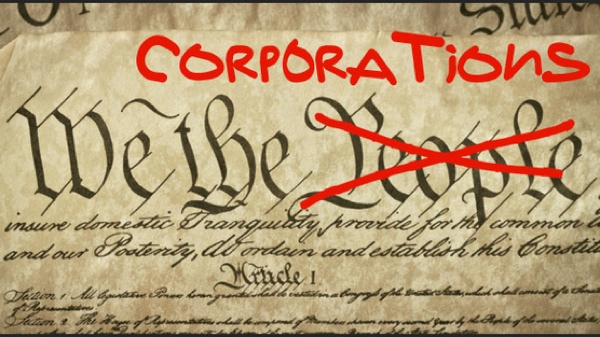
An Unfinished Democracy
In the first article of our Declaration of Independence from Corporate rule series, we explored how the American Revolution launched an unfinished struggle for self-governance.
The founders rejected rule by a distant monarchy and declared that legitimate authority comes from the people.
But in practice, “the people” meant something much narrower — primarily white, property-owning men.
It took generations of struggle - from the abolition of slavery to women's suffrage to the civil rights movement - to begin expanding those rights to others.
And even as those hard-won gains pushed democracy forward, another force was rising in the opposite direction: the expansion of corporate power.
How did we end up here?
Industrialization & the Rise of Corporate Power
The late 19th and early 20th centuries transformed the United States. Railroads stitched the country together. Steel production exploded. Massive trusts and corporations consolidated control over entire industries.
With that growth came something new: concentrated economic power on a scale the Constitution’s framers never envisioned.
As corporations expanded, courts were increasingly asked a fundamental question:
How should the Constitution apply to these powerful, state-created entities?
One case often cited in this history is Santa Clara County v. Southern Pacific Railroad. While the decision itself focused on taxation, it became associated with the idea that corporations could be treated as “persons” under parts of the Constitution.
But that moment was not the end of the story — it was the beginning.
Over the following decades, a series of court decisions gradually extended constitutional protections originally meant for human beings to corporations. What started as a narrow legal interpretation evolved into a broad doctrine: corporations could claim rights under multiple amendments.
And the scale of that shift is often overlooked.
Between 1890 and 1910, the Supreme Court heard hundreds of cases involving the 14th Amendment.
Only 19 involved African Americans — the very people the amendment was written to protect.
A staggering 288 involved corporations.
The amendment designed to guarantee equal protection for formerly enslaved people was instead overwhelmingly used to expand corporate power.
Want to see how this developed over time?
Explore the full timeline of corporate constitutional rights → HERE
Beyond the First Amendment: A Broader Constitutional Shift
Today, conversations about corporate power often focus on the First Amendment — but the reality is much broader.
Over time, corporations have invoked multiple constitutional protections, including:
- First Amendment — to claim political spending as protected speech
- Fourth Amendment — to challenge inspections and oversight
- Fifth Amendment — to resist regulation under “takings” and due process claims
- Fourteenth Amendment — to assert equal protection and due process rights
This didn’t happen all at once. It developed case by case, decision by decision — a legal evolution that fundamentally reshaped the balance between public authority and private power.
Two modern rulings helped accelerate this trajectory:
- Buckley v. Valeo — equating money in elections with political speech
- Citizens United v. FEC — allowing unlimited corporate political spending
Together, these decisions didn’t create corporate power — they supercharged it.
From Legal Doctrine to Political Reality
The consequences are visible everywhere — and not just in campaign finance.
Corporate constitutional rights are routinely used to:
- Challenge labor protections
- Weaken environmental safeguards
- Block public health regulations
- Resist consumer protections
At the same time, corporate lobbying and political spending shape nearly every major policy debate — from healthcare and housing to climate policy, taxation, and war.
This isn’t a collection of separate problems.
It’s a pattern.
Every crisis we face — rising healthcare costs, climate instability, unaffordable housing, endless war, economic inequality — is connected by a common thread: the outsized influence of concentrated corporate power.
Lobbying expenditures hit record highs.
Campaign spending continues to surge.
The result is a system where economic power translates directly into political influence.
Which raises a fundamental democratic question:
If concentrated wealth can shape laws, challenge regulations, and influence elections — who is government really accountable to?
A Pattern in History — Not an Accident
Corporate rule didn’t just happen.
And it wasn’t inevitable.
It was built — through legal decisions, political choices, and economic shifts over time.
But history shows something else, too:
What has been built can be changed.
The same Constitution that has been used to expand corporate power has also been reshaped through struggle:
-
The abolition of slavery
-
The expansion of voting rights
-
The civil rights movement
Each moment reminds us:
The Constitution is not static.
It is shaped by people organizing to redefine power.
Why Amendments Matter
The Bill of Rights and subsequent amendments were designed to protect human freedom and democratic self-governance.
But when those protections are extended to corporations — entities created by law, not living members of a community — the balance shifts.
What were meant to be shields for people can become tools for concentrated power.
That’s why amendments exist in the first place:
to correct course when legal interpretations move the system away from democratic control.
The Question of Our Time
Today, Americans across the political spectrum are asking:
What should democracy look like in the 21st century?
But the real question is even more fundamental:
Who has constitutional rights — human beings, or corporations?
Because as long as corporations can claim constitutional rights,
they will continue to use them to dominate our political system.
Across the country, people are searching for solutions.
The We the People Amendment, which would clarify that:
- Constitutional rights belong to natural persons only
- Money spent in elections "shall" be regulated
This isn’t a reform around the edges.
It’s a structural change — aimed at ending corporate rule at its source.
Like the movements that expanded democracy before us, this is part of a long tradition:
people coming together to build power and redefine what self-governance truly means.
The Bottom Line
Corporate rule wasn’t inevitable.
It was built — case by case, decision by decision.
And what was built can be changed.
Learn → Explore the full timeline of corporate constitutional rights HERE
Share → Help others understand how this system developed
Act → Join the movement to democratize the Constitution

