
1776 Was Only the Beginning
Series Introduction
Two hundred fifty years ago, the Boston Tea Party was not just a protest over tea—it was a rebellion against corporate rule.
The British East India Company was granted special privileges by the Crown, allowed to undercut local merchants, and shielded by a distant government that ignored the will of the people. Colonists recognized what we still face today: when corporations are given political power, democracy erodes.
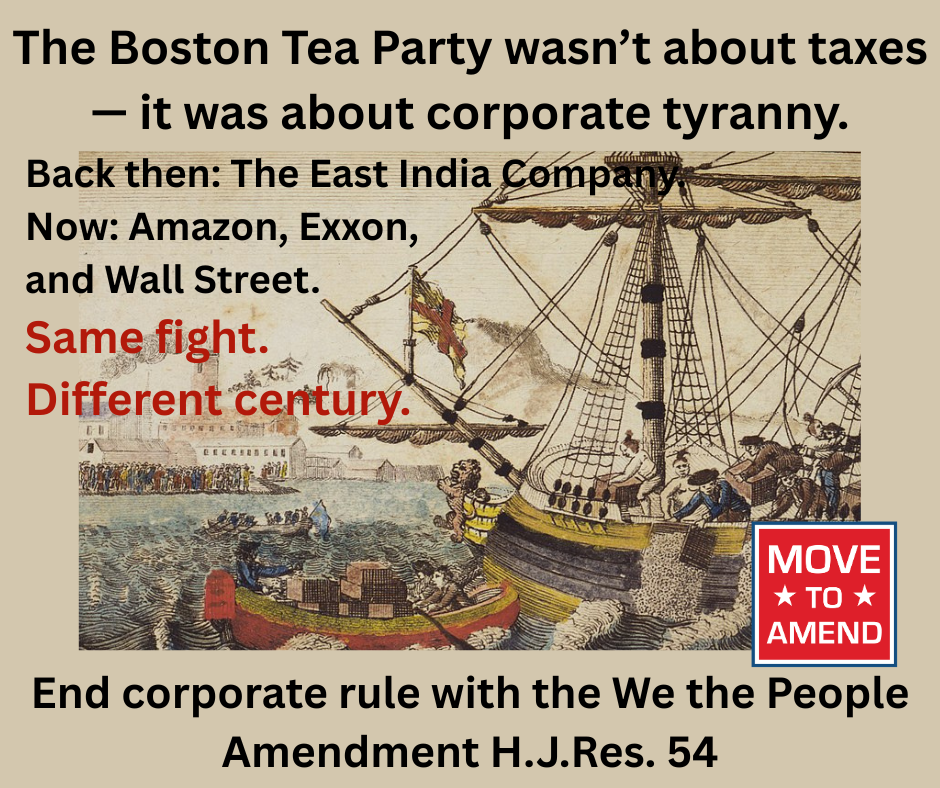
Move to Amend carries forward that unfinished revolution, working to end the legal doctrines that grant corporations constitutional rights and treat money as free speech. Just as the patriots dumped tea to oppose governance shaped by corporate monopoly, we organize today to build what democracy has always promised — a system where We the People, not corporate entities, decide the direction of our democracy.
Every generation has been forced to ask the same question in its own time: who governs — concentrated power, or the people?
As the country approaches the 250th anniversary of the Declaration of Independence, Move to Amend is launching a new series, Declaration of Independence from Corporate Rule, to explore that question in the present moment.
In the months ahead, we will look at how corporations gained constitutional rights, why so many of today’s crises share a common root, and how constitutional change has historically expanded democracy when existing systems no longer served the public good.
This series is not about looking backward. It is about understanding the work that remains unfinished — and the role each generation plays in carrying democracy forward.
Part 1: 1776 Was Only the Beginning
On a cold December night in 1773, men gathered quietly along the edge of Boston Harbor. The ships were already there, their cargo sitting in the water — tea owned by the powerful East India Company, protected by the British government and backed by law.
The conflict wasn’t simply about tea. And it wasn’t only about taxes.
Colonists understood something deeper was happening. A corporation had been granted special economic privilege by a distant government, allowing it to undercut local merchants while ordinary people had little voice in the decisions shaping their lives. Economic power and political authority had merged, and the consequences were felt by everyone.
What followed became known as the Boston Tea Party. It is often remembered as an act of protest, but at its core it reflected a growing realization: when power becomes concentrated and unaccountable, self-government begins to disappear.
Three years later, the Declaration of Independence gave language to that realization.
It declared that legitimate power comes from the consent of the governed — not from inherited authority, and not from institutions granted power beyond public control. Independence was not only about separation from Britain. It was about rejecting a system in which decisions were made without democratic accountability.
Today, as the country observes Presidents Day, we are reminded that the presidency itself was created within that same experiment in self-government. The office was never intended to stand above the people, but to exist within a constitutional system designed to limit concentrated power and ensure accountability.
Presidents Day is often framed as a celebration of individual leaders. But it is also a moment to reflect on a deeper question: whether our system of government still reflects the principle that no person — and no institution — stands above democratic accountability.
That question feels especially urgent in this 250th anniversary year of the Declaration of Independence. Rather than arriving in a time of democratic confidence, this moment comes as many people feel that the institutions meant to serve the public are drifting further from public accountability. The question before us is not only what happened in 1776, but what independence means when concentrated power once again tests the limits of self-government.
At the time of the Declaration, many people were excluded from its promise. Democracy expanded only through generations of struggle — through movements that demanded constitutional change when the system fell short. Each generation has faced the same question in a new form: who governs — concentrated power, or the people?
Today, that question has returned under different conditions.
We no longer live under a monarchy, but we do live within a system where massive corporations exercise extraordinary influence over our political system, economy, and daily lives. Over time, court decisions transformed corporations into holders of constitutional rights and treated money spent in politics as protected speech, allowing concentrated wealth to shape political outcomes at a scale ordinary people cannot match.
The consequences are visible across the crises people experience every day — rising healthcare costs, climate instability, economic insecurity, and political decisions shaped long before the public has a meaningful voice. These challenges may appear separate, but they share a common root: concentrated power operating beyond democratic accountability.
The United States has long described itself as a democratic experiment. Experiments endure only when they are maintained and corrected when they drift from their purpose. History shows that democracy weakens when people come to believe participation no longer matters and accountability is impossible.
This moment is a warning — and an opportunity.
When structural problems cannot be solved through ordinary legislation, Americans have turned to constitutional change. Amendments abolished slavery, expanded voting rights, and strengthened democratic participation when earlier systems failed to do so.
Today, many of our challenges stem from a similar structural problem: the expansion of constitutional rights to corporations and the doctrine that money in politics is speech. As long as these doctrines remain in place, efforts to address individual crises will continue to encounter the same barrier.
That is why people across the country are working to pass the We the People Amendment (H.J.Res. 54), a constitutional amendment to affirm that constitutional rights belong to human beings, not corporations, and that money spent to influence elections can be regulated to protect democratic self-government.
The amendment is not about limiting democracy. It is about making democracy possible.
As we reflect during Black History Month, on Presidents Day, and in this 250th anniversary year of the Declaration of Independence, we are reminded that independence is not declared once and secured forever. It is something each generation must choose to build.
Take the next step
Learn more about the We the People Amendment (H.J.Res. 54), sign the petition, and volunteer with Move to Amend to help build a democracy where people — not corporations — govern.
Because the work of independence continues. And it belongs to all of us.

