
In Part 1 of this series, we explored how resistance to concentrated economic power helped spark the American Revolution itself. In Part 2, we examined how corporations gradually acquired constitutional rights that were never mentioned in the Constitution and were never intended by its framers.
Together, those histories reveal an important truth: democracy has never been static.
Throughout American history, ordinary people have repeatedly organized to expand political participation, challenge concentrations of power, and push the Constitution closer to its democratic promise.
Constitutional change is not a rare accident.
It is a recurring feature of American democracy
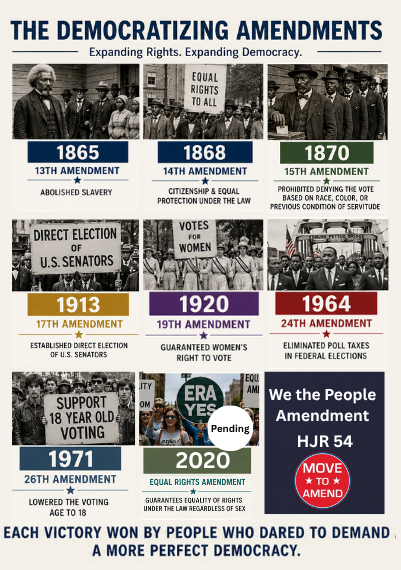
Pt 3: Democracy Expands When People Demand ItThe Constitution Has Changed BeforeMany of the rights Americans now take for granted were once considered radical, unrealistic, or impossible. Yet major democratic advances became reality because movements organized, educated, protested, petitioned, and built public support over time..Each amendment expanded democratic participation, challenged entrenched power, or strengthened political equality. None appeared overnight. Each emerged after years—or decades—of public education, organizing, and civic engagement. For a deeper look at how these movements achieved meaningful change explore Cultural Change for the We the People Amendment - Move to Amend Every Era Faces Its Own Democracy QuestionThe abolition movement forced Americans to confront whether human beings could be treated as property. The women's suffrage movement challenged the exclusion of half the population from political participation. The civil rights movement exposed the contradiction between democratic ideals and racial discrimination. Each generation inherited democratic institutions that fell short of their stated principles—and each generation was forced to decide whether to accept those limits or challenge them. The crisis of our time: Should artificial entities possess constitutional rights intended for human beings? And closely connected to that question: Should spending money to influence elections be treated as the same thing as speech? When Money Becomes Political PowerThe idea that money equals speech has reshaped American politics. Modern elections depend on fundraising, large donors, independent expenditures, Super PACs, and corporate spending. While ordinary citizens may have one vote, wealthy interests often possess vastly greater resources to shape political campaigns, advertising, lobbying efforts, and public debate. This does not simply affect who wins elections. It affects which issues receive attention, which voices are amplified, and which concerns are ignored. Communities may organize for years around healthcare, environmental protection, workers' rights, housing, or civil liberties, only to find themselves competing against organizations capable of spending millions of dollars to influence public opinion and government policy. The result - political influence is no longer distributed equally. Corporate Speech vs. Human SpeechThe First Amendment protects freedom of speech, freedom of the press, freedom of assembly, freedom of religion and the right to petition government. These protections were designed to safeguard human participation in self-government. But corporations are not human beings. They do not experience the consequences of public policy in the way people do. Yet a series of court decisions has increasingly treated corporate political spending as protected speech, granting artificial entities many of the same constitutional protections originally intended for living people. This raises a fundamental democratic question: When a corporation can spend unlimited resources to influence elections, public opinion, or legislation, whose voice is actually being protected? Why This Matters Beyond ElectionsThe debate over money and speech extends far beyond campaign finance. It shapes the broader public conversation. Who can afford to dominate media markets? Who can fund massive public relations campaigns? Who can influence legislation, regulation, and enforcement? Who can drown out grassroots voices? Democracy depends upon more than the right to speak. It also depends upon people having a meaningful opportunity to be heard. As concentrated wealth gains greater power over public discourse, many citizens, journalists, organizers, whistleblowers, and protest movements face increasingly unequal conditions in the struggle to shape public debate. The question is not whether speech should be free. The question is whether democratic participation is meaningful when political influence is tied to wealth. The Next Democratizing Amendment?Throughout American history, constitutional amendments have often emerged when the country recognized that existing systems no longer reflected its democratic ideals. The amendments that expanded voting rights, broadened representation, and challenged concentrations of power were not departures from democracy. They were efforts to fulfill it. Today, corporate constitutional rights and unlimited political spending have created a similar democratic imbalance. The We the People Amendment (H.J.Res. 54) proposes a constitutional response by establishing that constitutional rights belong to human beings only and that money spent to influence elections can be regulated. Democracy evolves when people engage in public dialogue about who holds power, whose voices matter, and how self-government should function. Every generation has faced that conversation. Ours is no different. As the nation approaches the 250th anniversary of the Declaration of Independence, the question remains what it has always been: Will democracy continue to be shaped by concentrated power—or by We the People? |
|
|

